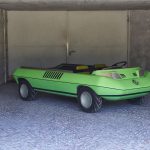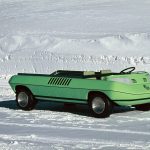


As a design firm, Gruppo Bertone was at its heyday in the early 1970s, having its hands in all kinds of projects. One of those projects was the Go, a design and operating prototype meant to lure Suzuki into exploring niche vehicles with the firm.
The ploy didn’t work, but it did create this extremely unique and fun little amphibious truck. Yes, I said amphibious.
In 1971, Bertone was exploring collaborations with various automakers beyond its usual one-off or special order. Marcello Gandini, a designer at Bertone at the time, was working on that front. His idea for the Go was to combine a two-seat, barchetta-style truck with a Suzuki motorcycle engine and amphibious body. Gandini and his team were quite clever in how they went about designing this niche truck.
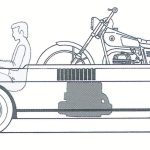
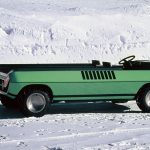
The left-hand drive Go had its engine behind the driver’s seat and its radiator and cooling behind the passenger at the right. A truck bed, designed to accommodate a snowmobile or off-road motorcycle, finished the basics of the chassis. Small off-road tires and a long wheelbase to balance loads completed the basic foundation.
A three cylinder, 67 brake HP Suzuki engine turned a chain that connected to a five-speed differential-inverter. This acted as a gearbox, giving five speeds in both forward and reverse at the rear axle. Similarly, the tailgate of the Go could be raised and lowered via the steering wheel, which acted as a lever via a pulley system. The tailgate doubled as a ramp and the pulley system allowed heavier loads to be borne by it when needed.
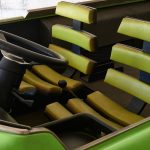
The bodywork of the Go was inspired by rubber dinghies and was designed in one piece so as to be able to float like one. An outboard motor could be attached to drive in the water when required. Similarly, the seats were designed to have less surface area to dry when wet and were padded vinyl-plastic in order to shed water easily. Both the engine and radiator were vented above the waterline of the Go truck to prevent drowning.
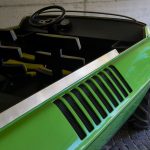
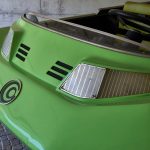
Bertone unveiled the Suzuki Go at the Brussels Motor Show in 1972. Its design was more about practicality and engineering than it was about jazzy looks and eyeball-grabbing appeal. It is also the earliest known example of Gandini’s asymmetrical design motif that would come to mark his name as a designer. The Go’s vents are more numerous on the engine side.
The Suzuki Go remained in the Bertone Museum until the company folded in 2014. It is now in the Automotoclub Storico Italiano (ASI) Bertone collection in Volandia, Italy. Photographs here are courtesy of the archives of the Ministero Della Cultura. Photos include some historic photography from 1972 and some taken during the transfer of the Go from the Bertone Museum to ASI in 2015.