

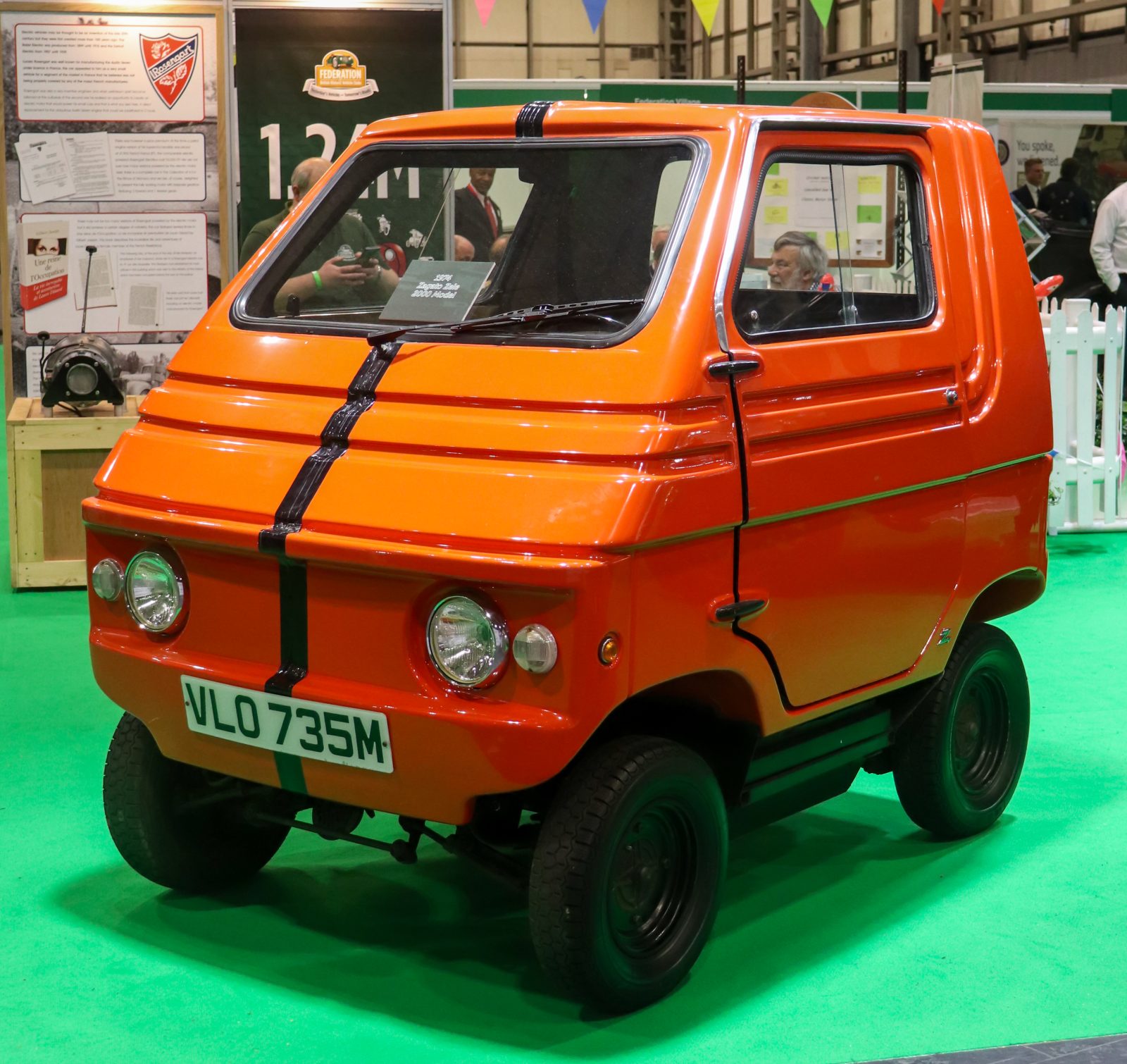
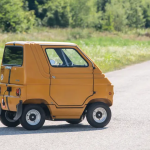
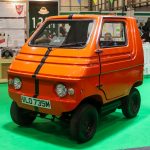
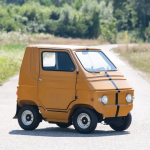
The Zagato Zele, also known as the Elcar in the U.S., was an electric microcar made during the 1970s oil crisis. Unlike other Zagato designs, the Zele was neither beautiful nor performance-oriented. It was, instead, shaped like a tuna can that’d been hit with a straight edge too many times.
The Zele was the design house’s response to the oil crisis of the mid-1970s. Made to be cheap, easy to park, and simple to maintain, the Zele came in three options: 1000, 1500, and 2000. Each with a little more power than the last, with the numbers corresponding to the motor wattage in that particular model.
About 500 of these microcars were made over about two years of production in all, most of them remaining in Europe; though a few came to North America. Top speed in the Zele depended on model, but was around 20 mph or so. The top-end 2000 had a boost switch which weakened the motor’s magnetic coils to allow slightly more speed. It topped out around 30 mph. Total range was about 50 miles per charge.
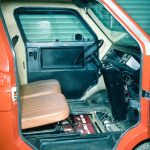
The Zagato Zele was made from a Fiat 500 and 124 chassis and suspension. Bodywork was in fiberglass and plastic and came pre-colored in any of 7 colors. Typical of the 70s, these colors ranged from brown to bright orange and pastel blue. The motor was a Marelli direct drive which went through a differential to the rear wheels. Four twelve-volt batteries were standard, but up to eight batteries could be included in the 2000 model.
The little Zele had a wheelbase of just 51 inches, a total height of only 63.5 inches, and a total length of 84 inches. Its curb weight was 1,091 pounds.
The Zele was produced at Zegato’s plant in Milan, Italy. It was imported to the U.S. by Elcar, who also converted some into “Wagonette” models with more seating.
The little car is now found in museums and collections around the world, with several on display in Europe. One recently came up for sale at Sotheby’s where it sold for £11,500 (~$15,425).
Photos are courtesy of Wikimedia and RM Sotheby’s.

