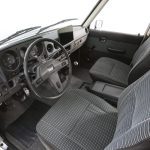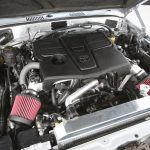


Toyota has revealed the Turbo Trail Cruiser, a bespoke concept build that marries the heritage of the classic Land Cruiser FJ60 with modern performance engineering. Debuting at the 2025 SEMA Show, the project is both a restomod and a statement of how Toyota envisions integrating new-era technologies into iconic platforms.
Key Technical Highlights
- The donor vehicle is a 1985 FJ60, restored and modified to retain its original character while incorporating significant upgrades.
- Powertrain: Toyota’s i-FORCE 3.4-liter twin-turbo V6 (from current Tundra) installed, delivering 389 horsepower and 479 lb-ft of torque, nearly double the output of the original FJ60 inline-six.
- Engine integration was engineered without altering the FJ60’s structural firewall, mount points or basic architecture. Custom motor mounts, adapter plate, and redesigned oil pan were used.
- Supporting modifications: custom exhaust system, a new heat exchanger in original mounting points, custom wiring harness; chassis tweaks include 1.5-inch lift, 35-inch tires, front shackle reversal.
- Aesthetics and interior: Finished in a reproduction of Toyota’s “Silver 147” colour; interior gets modern touches (eg. updated stereo) but is designed to maintain classic feel.
Strategic and Brand Implications
- The build underscores Toyota’s “multi-pathway” strategy: while electrified and fuel-cell vehicles remain important, gasoline-powered builds still have a role.
- As Toyota’s spokesperson put it, the Turbo Trail Cruiser “shows how seamlessly Toyota technology can elevate the driving experience” while preserving enthusiast-oriented character.
- For the enthusiast community, this project serves as a tangible demonstration of Toyota’s engineering capabilities — not just in new-model development, but in performance and heritage integration.
Why It Matters
- It bridges two domains: restoration (preserving classic vehicle character) and performance engineering (modern powertrain, drivability).
- It signals that Toyota values its legacy models and the enthusiast market — showing that the brand is willing to explore “hot-rod / resto” territory.
- From a technological viewpoint, the fact that the twin-turbo V6 was adapted into a platform from the 1980s with minimal structural changes shows a high level of modular flexibility and engineering ingenuity.
Potential Takeaways for the Market / Enthusiasts
- Restomod builds like this may increasingly influence aftermarket and OEM-approved conversions.
- For owners of older Land Cruisers or similar platforms, this shows what’s technically feasible — though Toyota notes the vehicle is a prototype and that modifications may affect street legality and warranty.
- The balance of maintaining “factory-original appearance” while inserting modern hardware may become a more standard template for OEM-supported enthusiast builds.