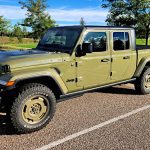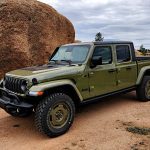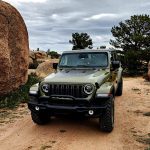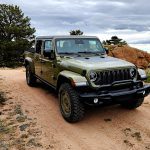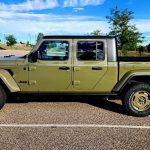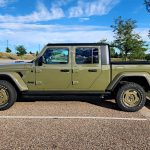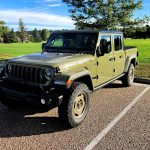

The 2026 Jeep Gladiator is a reminder that automotive engineering doesn’t always have to make sense. Most midsize pickups are designed around a fairly straightforward idea: build a truck that can carry stuff, tow stuff, fit into a parking space without requiring a spotter, and behave reasonably well on pavement.
Then there’s the Gladiator. The Gladiator is what happens when someone at Jeep looks at a Wrangler, notices that it doesn’t have a pickup bed, and says, “That ain’t right.”
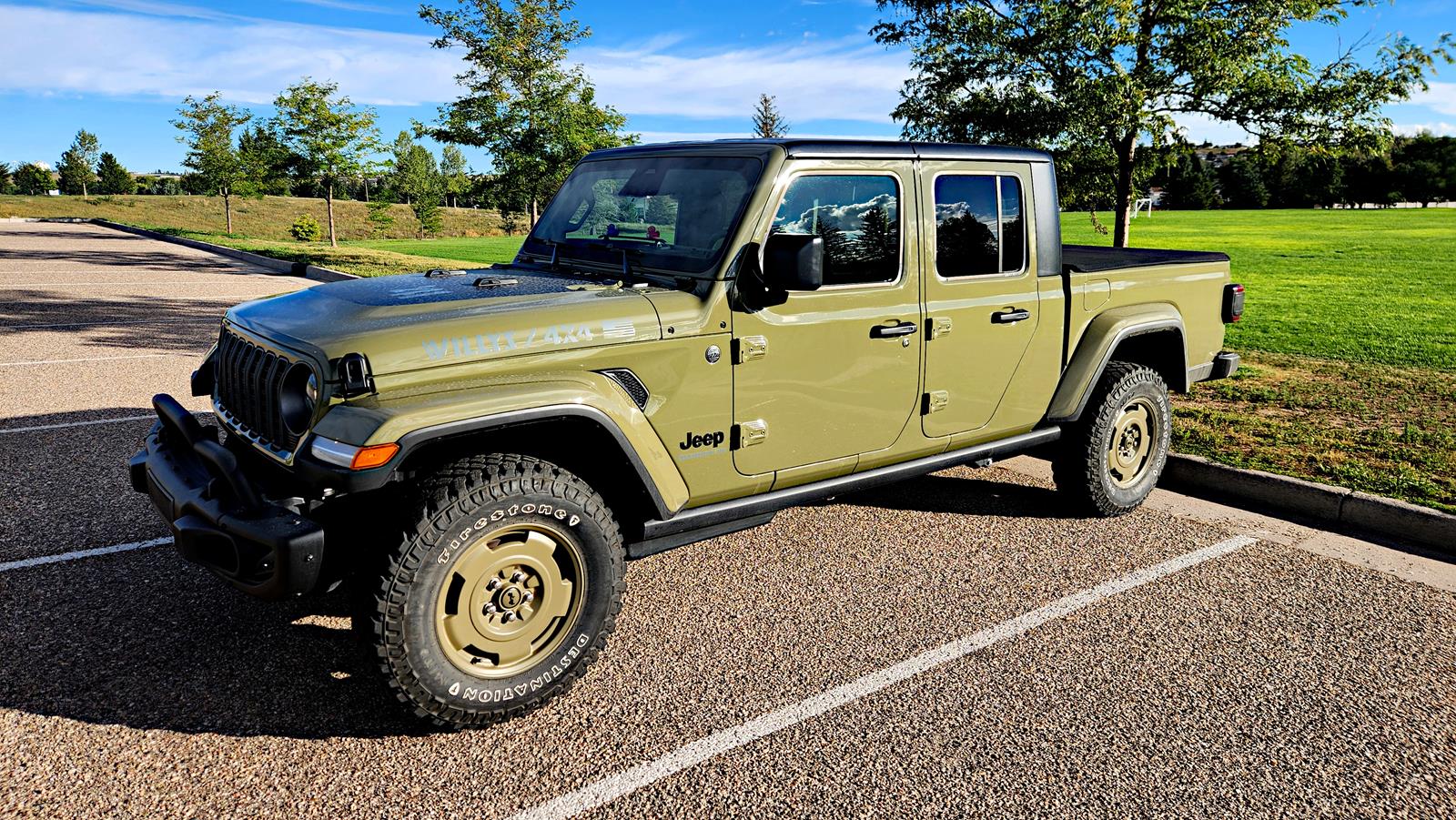
The result remains gloriously ridiculous. It has removable doors. A removable roof. A folding windshield. Solid axles. Serious four-wheel-drive hardware. And a five-foot pickup bed bolted onto the back. It is, in other words, a pickup truck designed by people who apparently believe that practicality is important, provided it doesn’t interfere with having fun.
For 2026, the formula remains largely unchanged. The Gladiator continues with the naturally aspirated 3.6-liter Pentastar V6 making 285 horsepower and 260 lb-ft of torque; paired with an eight-speed automatic. There is no turbocharged four-cylinder, no diesel, and no hybrid powertrain. Just the V6 and four-wheel drive. And honestly, that simplicity has some appeal.
It’s Still a Wrangler With a Bed
The easiest way to understand the Gladiator is to stop thinking of it as a conventional pickup. It’s a Wrangler that somebody stretched, reinforced and gave a bed. Sure, it has a bunch of Ram Truck stuff happening underneath to make that a reality, but in the end, it’s a Jeep.
That means it retains all the wonderful and occasionally maddening characteristics of the Wrangler platform. The seating position is upright. The windshield is close. The body is tall. The steering requires regular corrections on the highway. Wind noise is abundant. (Very abundant.)
With the top and doors removed, the Gladiator becomes an open-air experience that is almost impossible to replicate in another pickup. With everything installed, it becomes an experience that is almost impossible to replicate in another pickup because you can hear every single aerodynamic decision Jeep has ever made.
That’s the trade-off. You don’t buy a Gladiator because you want Lexus-like isolation. You buy it because you want to drive a pickup truck with no doors. Which is a perfectly rational purchasing decision if you don’t think about it too hard.
The V6 Is Old School, Too
The 3.6-liter Pentastar V6 isn’t particularly exotic. It makes 285 horsepower and 260 lb-ft, which is adequate rather than breathtaking. The engine needs revs to produce its best work, and the Gladiator isn’t exactly a featherweight. My own testing puts 0-to-60 mph around 7.2 or so seconds. Nobody is going to mistake the Gladiator for a drag racer.
The engine is smooth, predictable, and comfortably familiar. The eight-speed automatic does a good job of keeping the engine in its usable range, although there are moments when you wish Jeep had found another 50 lb-ft somewhere under the hood. That’s a #JeepThing.
This feeling of lack comes to the fore when you’re towing. And particularly when you’re climbing a mountain. And when you’re towing up a mountain. You know, the usual places where having more torque tends to be convenient.
Fuel economy isn’t exactly a Gladiator selling point, either. EPA estimates are around 17 mpg city and 22 mpg highway, or 19 mpg combined. I barely broke 15 in my week with it.
That’s what happens when you combine a brick-shaped vehicle, aggressive tires and four-wheel drive. You’ve seen the memes. A cow is more aerodynamic than a Jeep.
But Then the Pavement Ends
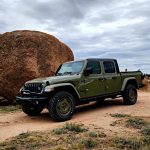
This is where the Gladiator starts making considerably more sense. On pavement, there are plenty of midsize pickups that are more refined. Off pavement, the Gladiator is playing an entirely different game.
Depending on configuration, you get serious axle hardware, low-range gearing, skid plates and specialized suspension systems. The Rubicon is particularly serious about crawling over things that would cause most pickup owners to immediately start looking for another way around.
The Mojave goes in a different direction, emphasizing high-speed desert running with suspension hardware designed to absorb punishment.
So you have a choice: Rubicon if you want to crawl over rocks, Mojave if you want to fly over dirt, and Sport if you mostly want to tell people you have a Jeep pickup.
All three are valid. The last one just involves more explaining at the gas station.
Then There’s the Bed
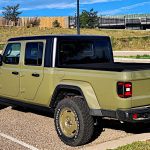
The Gladiator’s five-foot bed isn’t huge, but it’s useful. You can haul motorcycles, camping equipment, lumber, coolers, bicycles and all the other things pickup owners insist they need to carry.
The bed also has integrated tie-down points, and available features include a Trail Rail system and a 115-volt outlet.
But let’s be honest.
Nobody buys a Gladiator because they need the maximum possible cargo capacity. If hauling capacity is your primary concern, there are better choices. The Gladiator’s selling point is that you can carry your stuff while simultaneously removing the roof and doors.
It Can Tow, Too
The Gladiator can also tow considerably more than its appearance suggests. With the appropriate configuration, maximum towing capacity reaches 7,700 pounds, while maximum payload can reach 1,720 pounds. Those numbers are genuinely useful.
Of course, maximum ratings depend heavily on configuration. Not every Gladiator can tow 7,700 pounds. That’s worth remembering before you buy one and then discover your particular combination of wheels, tires, axle ratio, and equipment has turned your theoretical towing capacity into something considerably less impressive.
The Gladiator also has trailer-sway control to help keep things pointed in the same general direction. Which is nice. Because trailers have a remarkable ability to develop their own opinions.
The Daily-Driver Question
The Gladiator is perfectly usable as a daily driver. But “usable” isn’t the same thing as “comfortable.” The ride can be busy. The steering is vague compared with more conventional pickups. The solid-axle setup is excellent for off-roading but less interested in pretending potholes don’t exist.
And then there’s the wind. The Gladiator produces plenty of it. With the doors and roof installed, it’s still noisier than most modern pickups. Remove them and you’ve essentially turned the cabin into a conversation with Mother Nature.
At 70 mph, Mother Nature is loud. Very loud. Your passengers will learn to communicate through facial expressions.
The Interior Is Better Than It Has Any Right to Be
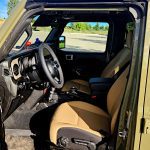
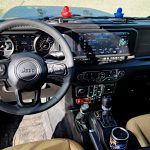
Fortunately, Jeep has improved the Gladiator’s interior substantially compared with early versions. The 2026 model gets a 12.3-inch touchscreen as standard, along with wireless Apple CarPlay and Android Auto.
The infotainment system is easy to use and the cabin is reasonably comfortable. There are still plenty of hard surfaces, but that isn’t necessarily a bad thing in an off-road truck. You can spill something. You can get mud in it. You can take the doors off without worrying that your $8,000 Italian leather interior is going to file a complaint.
The Gladiator is designed to be used.
The 2026 Problem: Not Much Is New
The biggest issue with the 2026 Gladiator isn’t really the Gladiator. It’s the fact that this is an aging design in a rapidly improving segment. For 2026, the Gladiator remains largely unchanged, although Jeep has made door removal easier with revised hinges and introduced additional special-edition models such as the Willys ’41. Which is what I drove this time.
Competitors have become increasingly sophisticated. Some offer better ride quality, more efficient engines and more modern powertrains. Jeep’s answer is essentially: “Yes, but can your pickup remove its doors?”
It’s difficult to argue with that logic. Mostly because the answer is usually no.
The 2026 Jeep Gladiator is not the best midsize pickup if your definition of “best” involves quiet highway manners, fuel economy, ride quality or maximum everyday practicality. And it isn’t supposed to be.
The Gladiator exists for a much smaller and considerably stranger group of buyers. People who want a pickup. People who want a Wrangler. And people who looked at those two things and decided they weren’t willing to choose.
It’s genuinely capable off-road, reasonably useful as a pickup, surprisingly capable when properly equipped for towing and endlessly entertaining with the roof and doors removed.
It is also noisy, thirsty, somewhat agricultural on pavement and powered by an engine that feels increasingly old-fashioned.
In other words, it’s a Jeep. And that’s really the point.
The 2026 Gladiator doesn’t apologize for being impractical in all the ways that make it interesting. It doesn’t try to become a luxury pickup. It doesn’t pretend to be a crossover. It doesn’t hide its solid axles, removable doors or ridiculous windshield. It embraces all of it.
In a world where almost every new vehicle is getting quieter, smoother, more automated and more sensible, there’s something strangely refreshing about a pickup that still seems to have escaped from a Jeep engineer’s weekend project.
Just remember to bring earplugs. And sunscreen. And probably a hat. The roof comes off, after all.