

Bugatti’s new Tourbillon is getting a lot of attention. And rightfully so. After all, it’s a hybridized, V16-powered, 1,800-horsepower monster that looks like it was sculpted by a wind tunnel with a PhD in haute couture. But underneath all that glitz and carbon fiber is something equally worth celebrating: integration. The kind of obsessive, granular packaging work that makes most engineering teams sweat just thinking about it. And that makes most mechanics take up pitchforks and torches.
This car isn’t just about throwing a thousand things at a wall to see what sticks. The Tourbillon is what happens when every component, every wire, every bolt has to justify its place.
V16 + Hybrid = Tight Squeeze
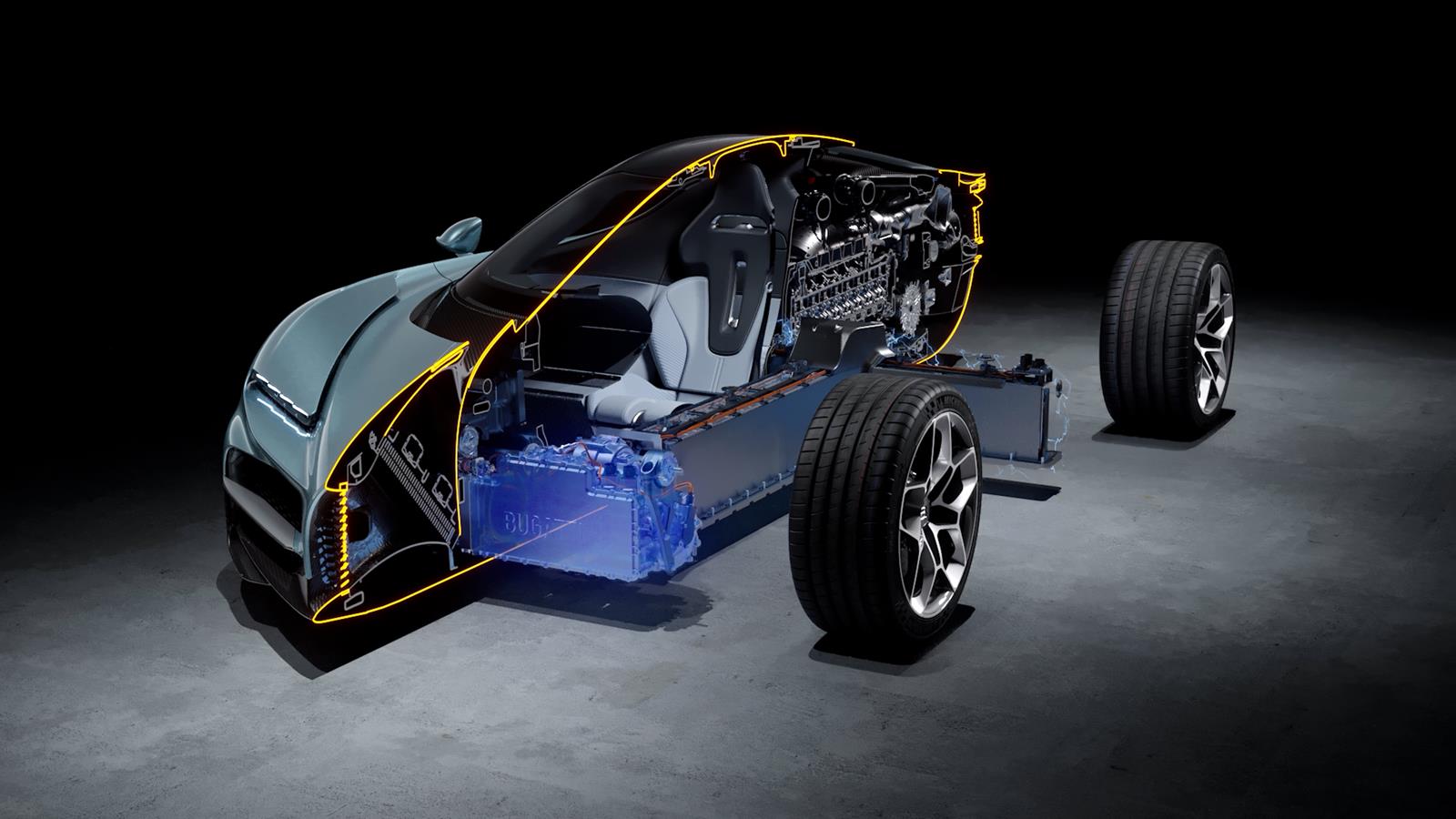
Let’s start with the obvious. Bugatti took an 8.3-liter naturally aspirated V16, developed with Cosworth (because, of course), and mated it to three electric motors. Two live up front, providing all-wheel drive and torque vectoring. The third is stuffed between the engine and an 8-speed dual-clutch transmission at the rear.
That combo delivers 1,800 horses, yes, but the real trick is how they fit it all together. The whole rear-drive unit, including engine, e-motor, and transmission, is short enough to avoid rear-end overhang that could throw off handling. And the 25-kWh battery? That’s wedged into the central tunnel and tucked behind the seats. It’s not just packaging, it’s made to be part of the car’s structural spine by doubling as reinforcement for the monocoque.
Bugatti’s done what many hybrids still can’t: integrated the electric and combustion elements into one cohesive whole. Without tacking things on willy-nilly.

Analog Tech in a Digital World
Inside, the Tourbillon continues its rebellion against over-digitization. (I’m pretty sure there’s a Madonna reference in there somewhere.) The Bugatti’s gauge cluster is an absolute masterpiece: a delicate arrangement of crystal, titanium, and aluminum that weighs barely more than a deck of cards and looks like it should be keeping time in a Geneva boutique.
Instead of floating screen dominance, you get a rotating display that tucks away when not needed, and an instrument pod that moves with the steering wheel’s vertical travel. It’s more complicated than it needs to be, of course. This being Bugatti.
The whole interior is mechanical art. You interact with jeweled, exposed-link switches that feel like winding a fine watch rather than operating a car. Everything you touch has weight, texture, and tactile feedback. It’s all very analog.. and that’s precisely the point.
Light Footed, Heavy on Capability
Despite being an all-wheel drive, V16-hybrid hyper-GT with 37 miles of EV-only range, the Tourbillon weighs in at just 1,995 kg (4,398 lb). That’s not exactly featherweight, but considering what’s stuffed into the thing, the number is downright miraculous.
Bugatti used 3D-printed titanium suspension arms, carbon-fiber-everything, and active aero that morphs the car’s profile on demand. Cooling ducts, air channels, and downforce-generating geometry are baked into every corner. Nothing’s wasted. Even the airflow through the front end serves double duty—cooling and stabilizing at 250+ mph.

Elegant Complexity
What’s most impressive about the Tourbillon isn’t just the numbers. It’s the fact that the complexity vanishes into elegance. It doesn’t scream “look at me” with oversized spoilers or gratuitous screens. Instead, it whispers, “I was engineered by people who read thermodynamic papers for fun.”
Every component is doing more than one job. Everything fits with millimeter precision. And everything you don’t see is just as important as what you do.
In the end, the Tourbillon isn’t just a next-gen Bugatti — it’s a thesis statement on how the best design doesn’t look designed at all. It just looks right.
And it just happens to hit 250 miles per hour while doing it.


