

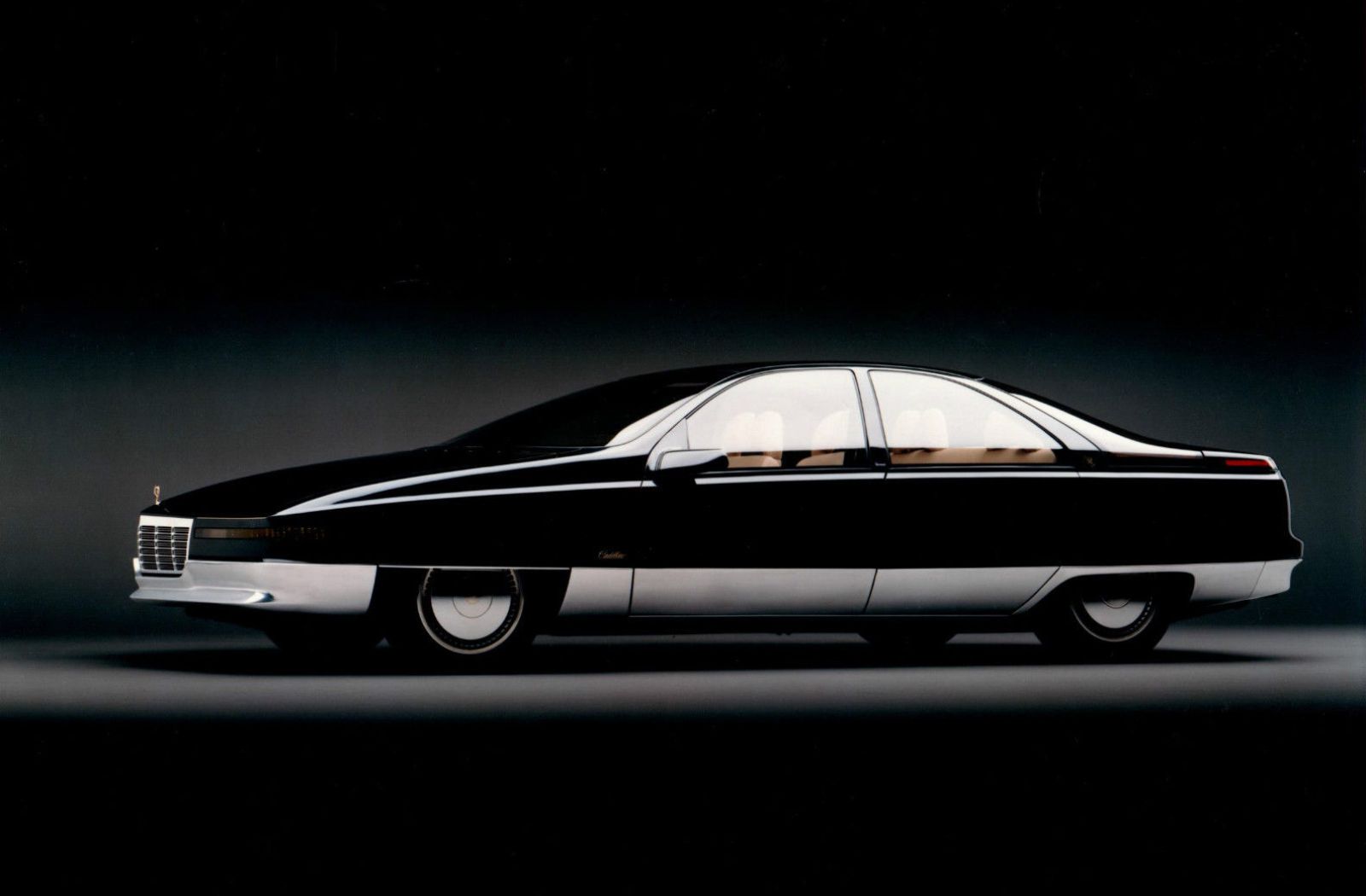
1988 was a pretty big year: the space shuttle Discovery launched, the first widespread Internet virus appeared (“the worm”), A Brief History of Time by Steven Hawking was published, the quintessential Christmas movie Die Hard released, I was angrily replacing my cassette collection with compact discs, Macho Man Randy Savage took the heavyweight title, and Cadillac unveiled the uber-futuristic Voyage concept.
The Cadillac Voyage was first shown at the Teamwork and Technology Show at the Waldorf Astoria in New York. It was announced as the “voyahhjeh” with a French(ish) pronunciation. Sounding European was all the rage back then. For Cadillac, the Voyage was pivotal. The brand was struggling to find a place in the fast-changing luxury vehicle arena where European models were dominating and American luxury options were considered sub-par.
Both Cadillac and Lincoln, America’s luxury brands, were floundering for a persona to compete with the Euro-vasion. Many might say that the 1988 Voyage was Caddy’s comeback. Lincoln has yet to do the same.
Cadillac’s Advanced Studio design chief Jerry Brochstein was the person most responsible for the Voyage’s look. The concept was a massive 212.6 inches long – longer than today’s Escalade. Every comfort feature imaginable and every futuristic technology option that could be thought of in 1988 was stuffed into this conceptual beast.

The wedge-like design gave the Voyage a low coefficient of drag (0.28, on par with the first-gen Prius). Even with the huge rear end and fat-bodied proportions. This concept was a tribute to unlimited wind tunnel access. Hidden windshield wipers, front skirts that shifted into turns, sleek side mirrors, sucked-in door handles, and body-integrated “bumperettes” all contributed to that low Cd. Harbingers of things that would become standard on many cars decades later.
The Voyage also featured an early keyless entry system similar to the one Ford would embrace in the 1990s. A keypad appeared on the door sill and a code was entered to unlock and open doors. From there, the interior took the show.
The glass roof allowed illuminated, open cabin space. A 20-way power-adjusted driver’s seat — yes, I said 20-way — with heat and massage was topped by a strange two-piece headrest. The passenger seat, while not as adjustable, had the rest of this as well.
This being 1988, a built-in phone (the height of luxury in the ’80s) was integrated into the driver’s armrest. A navigation system with a CRT-like display, and lights in red, amber, and green adorned the button-infused central dashboard. Thick airbags, knobs for all kinds of adjustments, and both rear and forward-looking cameras made up the rest.
Under the Voyage’s slightly domed hood was a big 4.5-liter V8 outputting 275 horsepower to a part-time all-wheel drive transmission, adjustable from rear-wheel to all-wheel automatically, on the fly. Though the car was never tested at full speed, GM thought it could easily break 200 mph and even had plans to put a V12 into the Voyage if given more time to develop the concept. That would come later.
The Voyage came at a time when most of these features were just dreams and were nowhere near production. LED exterior lighting was expensive and didn’t become common for another 40 years. Backup and night-vision forward cameras weren’t common for another 30. In-vehicle, GPS-based navigation wasn’t realistic for another decade.
The Voyage was followed by the Solitaire concept, which had the V12 and presented as a two-door version of the Voyage.
The current location of the Voyage and Solitaire concepts is unknown. But most indications are that they are now in General Motors’ historical collection. Photos herein are courtesy of Cadillac and GM.


