
Subaru has spent decades convincing Americans that the automobile is really just a portable piece of outdoor equipment. The formula is simple: add all-wheel drive, some ground clearance, a roof rack, and enough plastic cladding to suggest that the owner occasionally encounters mud. Then make commercials involving dogs. Easy.
But now there’s the 2026 Trailseeker.
It’s electric. And, somewhat surprisingly, it might be the Subaru EV that finally makes the whole concept click. Unlike the Solterra, which got quickly ignored once launched, the Trailseeker (while also being ignored by Subaru’s marketing department) is actually pretty good.
The Trailseeker is a midsize, two-row electric SUV with dual motors, standard all-wheel drive, 375 horsepower, 8.5 inches of ground clearance, and enough towing capacity to pull a small boat or camper. Subaru says it can travel up to 281 miles on a charge, depending on configuration. Pricing starts at $39,995 before destination and other fees.
Those are the potential upsides. In the real world, of course, towing means extremely limited range and actual real-world driving range is south of that EPA promise. Closer to 240, realistically.
Even with those caveats, though, the Trailseeker is considerably more interesting than the sort of appliance-shaped EV that was made by committee via Toyota. The Trailseeker actually looks like something Subaru would build. And it acts like it too. And that’s important.
It’s an Electric Wagon, Basically
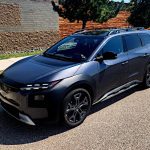
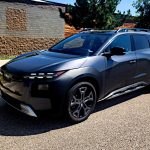
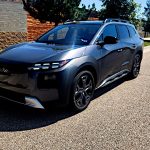
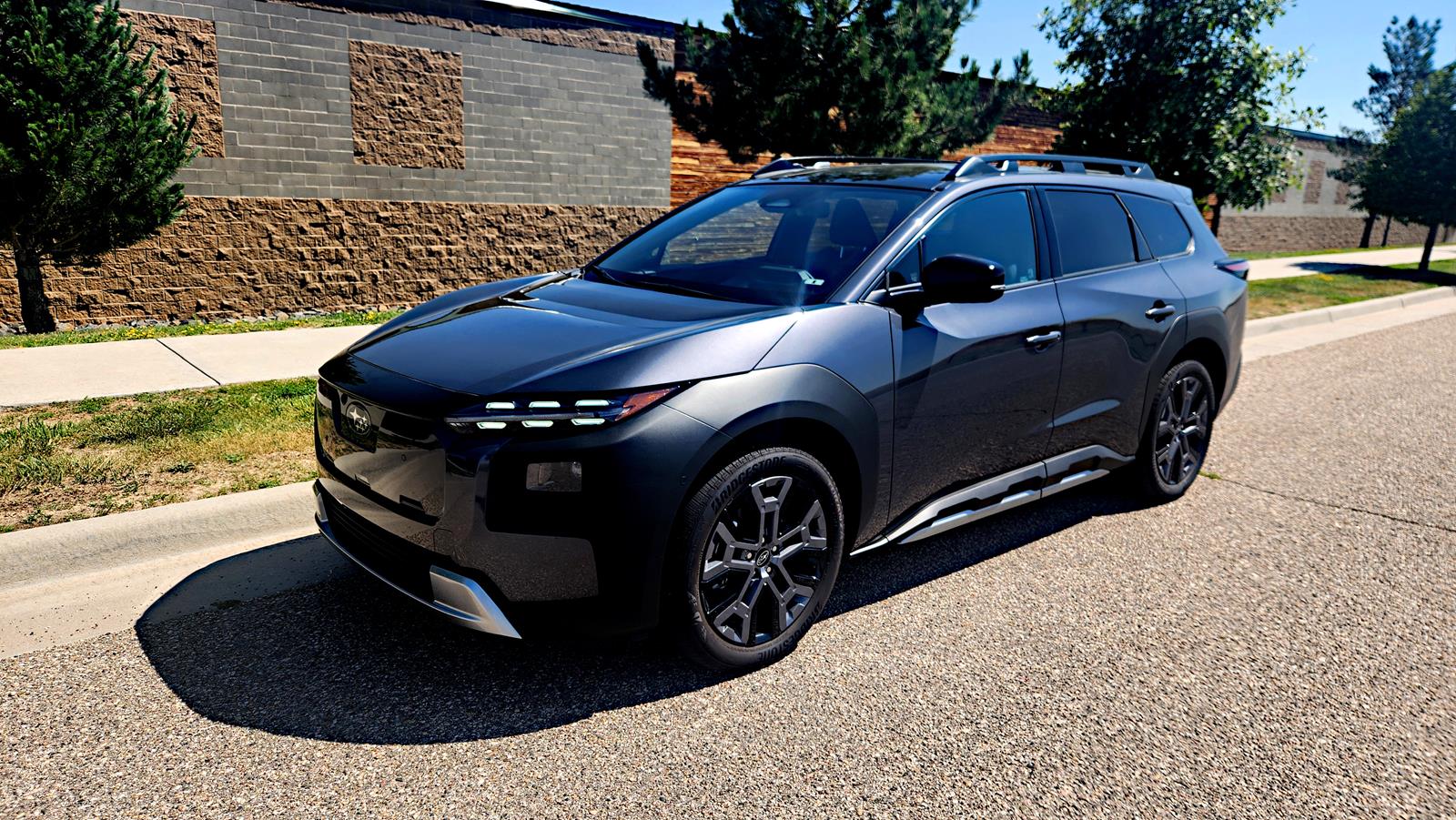
The Trailseeker is technically an SUV, but Subaru has wisely resisted the temptation to make it look like every other electric crossover on the planet. Unlike the Outback it’s loosely based upon, the Trailseeker hasn’t gone full box-shape.
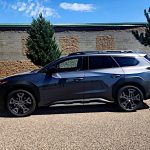
It’s long, relatively low, and wagon-ish. In fact, it looks remarkably like what might happen if somebody took a previous-generation Outback, removed the gasoline engine, and replaced it with a giant battery. In my opinion, it looks a lot better than the current-gen Outback does.
The Trailseeker shares its basic architecture with the Toyota bZ Woodland, including the dual-motor powertrain and general dimensions. Subaru, however, gives the vehicle its own styling and chassis tuning. It’s not a twin of its Toyota sibling. Thank goodness, because I am not a fan of the bZ.
So while you can see the Toyota DNA in this one, you can also see why Subaru wanted this vehicle.
The standard roof rails, chunky lower bodywork, substantial ground clearance and wagon proportions all make sense for a Subaru buyer. This isn’t an EV pretending that gravel roads don’t exist.
375 Horsepower Is a Lot of Subaru
The Trailseeker has two electric motors producing a combined 375 hp. That’s a rather entertaining amount of power for something that looks like it should be carrying a golden retriever and several REI bags.
That horsepower number and instant torque through AWD means that the Trailseeker can launch itself to 60 mph in about four seconds. Think about that for a moment. This is a Subaru wagon-like EV that can accelerate more quickly than a lot of vehicles wearing considerably more aggressive clothing. It’s a fast Subaru that doesn’t say WRX on it or have a suspension that requires a kidney transplant once you reach the age of 40.
The power delivery is immediate, smooth and completely predictable in the way electric motors tend to be. There’s no waiting for a turbocharger to spool or an automatic transmission to figure out which gear it wants. Push the accelerator and the Trailseeker simply goes.
This being more Outback than WRX, though, the Trailseeker’s suspension is tuned more toward comfort than corner carving, and the steering is relatively numb. But I’m fine with that. The Outback buyer is the audience here, not the rally fan.
It Actually Does the Subaru Things
Here’s where the Trailseeker gets interesting. Subaru didn’t just slap an EV powertrain underneath a wagon-shaped body and call it an adventure vehicle. Every Trailseeker gets 8.5 inches of ground clearance and standard all-wheel drive. It also gets Subaru’s X-Mode system, along with Snow/Dirt and Deep Snow/Mud settings, Grip Control and Downhill Assist.
Those features aren’t magic, of course. They won’t turn the Trailseeker into a Jeep Wrangler. But they make sense for the type of driving Subaru owners actually do. Fire roads? Sure. Snow-covered roads? Absolutely. Muddy trailhead? That’s basically the job description. Rock crawling? Maybe don’t.
Subaru’s off-road demonstrations have shown that the Trailseeker can handle surprisingly rough terrain for an EV crossover, particularly when equipped with the higher-end trims and their 360-degree camera system.
There’s also a 3,500-pound towing rating, which is useful enough to pull a small camper, boat or utility trailer. That combination of towing, clearance and AWD gives the Trailseeker something many electric crossovers don’t have: A reason to exist beyond commuting.
Range Is the Catch
Unfortunately, every EV review eventually arrives at the part where we discuss batteries.
The Trailseeker uses a 74.7-kWh battery and has a maximum DC fast-charging rate of 150 kW. EPA range is as high as 281 miles, although versions with larger wheels are rated at 274 miles.
Those numbers aren’t terrible. They’re just not particularly impressive anymore. And real-world highway driving exposes the problem. That basically cuts the range in half. Towing? Even more.
That’s where the Trailseeker’s adventure credentials start to collide with reality. A weekend warrior who drives 25 miles to work and spends Saturday exploring mountain roads probably won’t care. The person planning a 1,200-mile family road trip through Wyoming, Montana and Idaho might care quite a lot.
Fortunately, Subaru has equipped the Trailseeker with a NACS charging port and access to the Tesla Supercharger network. Subaru quotes approximately 28 minutes for a 10-to-80-percent DC fast charge under suitable conditions. If the port will actually work. Also iffy since many Tesla chargers aren’t using the current-generation standard and thus will not recognize non-Tesla vehicles. Thanks, Elon.
The Interior Is Practical, Not Revolutionary
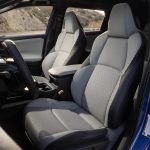
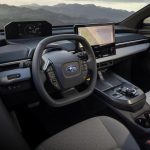
Inside, the Trailseeker follows the modern Subaru/Toyota EV playbook. There’s a 14-inch central touchscreen, a 7-inch digital gauge display, wireless Apple CarPlay and Android Auto, and plenty of standard driver-assistance technology.
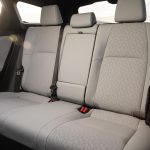
The cabin is spacious and comfortable. It’s also remarkably normal. That’s actually a compliment. I drove the Trailseeker right after having driven the Outback. Things are almost exactly the same between them.
There isn’t a desperate attempt to make the interior look like a spaceship in this EV. You don’t get a dashboard consisting entirely of screens and minimalist furniture designed to make you wonder where you put your coffee.
There are, however, some odd decisions.
There’s not a lot of small item storage in here. There is also no glovebox.
The Trailseeker’s driver-assistance technology works reasonably well, but the vehicle can be a little.. enthusiastic about supervision. Driver attention and hand position warnings are sometimes near-constant. Other times, it feels like one could fall asleep and the car wouldn’t even notice.
This is becoming an increasingly common problem with modern vehicles, so I can’t just blame Subaru for this. But most automakers have at least become consistently ignorant or annoying about it. This car is neither.
The Trailseeker also doesn’t provide true one-pedal driving. Regenerative braking can be adjusted, but the friction brake is still required to bring the vehicle completely to a stop. That’s an odd omission in an otherwise modern EV.
The Trailseeker Makes More Sense Than the Solterra
Perhaps the biggest question is where the Trailseeker fits alongside Subaru’s existing Solterra. The answer is fairly straightforward: The Trailseeker feels like the vehicle Subaru should have built in the first place.
It’s larger, more practical and more obviously aimed at Subaru’s core customer. It retains the company’s all-wheel-drive identity while adding genuine electric performance and useful ground clearance.
It also looks better suited to Subaru’s personality. The Solterra often feels like an EV Subaru happens to sell. The Trailseeker feels like a Subaru that happens to be an EV. That’s a meaningful distinction.
So Should You Buy One?
The 2026 Subaru Trailseeker isn’t perfect. Its highway range is merely adequate, its charging performance is hardly class-leading, regenerative braking could be better, and the driver-monitoring system occasionally behaves like an overly concerned parent sitting in the passenger seat.
But the Trailseeker gets the important stuff right. It’s comfortable. It’s quick. It’s roomy. It has genuine ground clearance. It has standard all-wheel drive. It can venture onto dirt and snow without immediately looking like it needs an apology from the marketing department. And, perhaps most importantly, it feels like a Subaru.
At a starting price of $39,995, the Trailseeker also undercuts many similarly sized electric SUVs. Subaru’s own pricing shows the Limited starting at $43,995 and the Touring at $46,555 before destination and options.
The biggest question isn’t whether the Trailseeker is capable. It clearly is.
The question is whether 274–281 miles of EPA range is enough for Subaru buyers who routinely think nothing of driving 200 miles into the wilderness because someone on Reddit said there was a “pretty easy trail” up there.
For the right owner, it probably is. And that may be the Trailseeker’s greatest accomplishment. It doesn’t try to convince Subaru buyers to become EV people. It tries to convince EV buyers that they can still be Subaru people. That’s a much smarter pitch.