
There was a time when buying a Mercedes-AMG performance sedan meant getting a large engine, a sophisticated chassis, and enough horsepower to make your insurance agent reconsider the relationship. The formula was straightforward: Take a nice Mercedes-Benz, let the AMG engineers loose on it, and give the result a healthy appetite for premium gasoline.
The 2026 Mercedes-AMG E53 takes a slightly different approach. It still has a turbocharged inline-six, sophisticated suspension hardware, and the sort of performance that makes merging onto the interstate a brief but memorable experience. However, it also has a plug-in hybrid powertrain, a sizable battery, and piles of digital technology inside the cabin.
The result is a luxury sport sedan that can commute on electricity, devour a winding road, and transport its occupants in considerable comfort. It is also a complicated, expensive machine that occasionally seems determined to solve problems nobody knew they had.
A Different Kind of AMG
Under the hood sits a turbocharged 3.0-liter inline-six producing 443 horsepower and 413 lb-ft of torque. An electric motor contributes another 161 horsepower and 354 lb-ft, with a 21.2-kWh usable battery providing the electrons.
Combined output reaches 577 horsepower and 553 lb-ft of torque. Add the optional AMG Dynamic Plus package, engage Race Start mode, and the system can briefly deliver 604 horsepower.
Power travels through a nine-speed automatic transmission to Mercedes-AMG’s fully variable 4MATIC+ all-wheel-drive system.
Those numbers put the E53 firmly in serious-performance territory. Mercedes estimates a 0-to-60-mph time of approximately four seconds, dropping to 3.8 seconds with Race Start. On my own, on public roads, 4.5 seconds was the norm.
The important distinction is that the E53 doesn’t rely entirely on its gasoline engine to deliver the goods. The electric motor supplies immediate torque, helping the car leap forward before the turbocharged six-cylinder has fully settled into its stride. This creates a very smooth launch.
That electrical assistance also makes ordinary driving remarkably effortless. Passing slower traffic requires little planning, and accelerating onto a freeway doesn’t involve waiting for the engine to finish discussing its options with the turbocharger.
Of course, there is a price for all this engineering. The E53 is a heavy car, with the sedan weighing well over two tons. Batteries, electric motors, and associated hardware have to go somewhere, and physics insists that none of them are weightless. The clever part is how well Mercedes hides that mass.
Performance Without the Punishment
The E53 comes equipped with adaptive suspension, rear-wheel steering, and performance-oriented braking hardware. These systems help the car feel considerably more agile than its weight might suggest.
Rear-wheel steering is particularly useful. At lower speeds, the rear wheels turn in the opposite direction to the fronts, reducing the effective turning circle. At higher speeds, they turn in the same direction to improve stability during lane changes and quick transitions.
It’s the sort of technology that sounds like an expensive solution to an engineering problem until you drive a large performance wagon through a tight parking garage or a series of sweeping bends. Then it makes sense.
The suspension can also adjust its behavior according to the selected driving mode. In its more relaxed settings, the E53 behaves like a proper luxury Mercedes, absorbing ordinary road imperfections without making every expansion joint a personal insult.
Switch to the sportier modes, and the car tightens its responses. Steering, throttle behavior, transmission programming, and suspension settings become more aggressive, allowing the E53 to feel considerably more alert. It isn’t a lightweight sports car, and pretending otherwise would be silly. There is still substantial mass to manage when braking hard or changing direction abruptly. Nevertheless, the E53 offers a convincing blend of composure and speed. It can cover ground quickly without demanding that its occupants endure a race-car suspension setup on the way to the grocery store.
The brakes deserve attention, too. They provide the stopping power expected of a car capable of such acceleration, although blending regenerative braking with conventional friction brakes can make pedal response less consistent than enthusiasts might prefer.
That’s one of the recurring challenges with performance hybrids: Making a car accelerate like a missile is relatively straightforward. Making every transition between electrical regeneration and conventional braking feel perfectly natural is another matter.
The Plug-In Hybrid Advantage
The E53’s 21.2-kWh usable battery provides an EPA-estimated 42 miles of electric-only range for the sedan. That is enough for many daily commutes, provided the driver has access to charging and doesn’t treat every traffic light as the starting line at Le Mans.
The car can operate in electric mode, allowing local errands and shorter trips to happen without the gasoline engine running. When the battery charge is depleted or additional power is required, the combustion engine joins the party.
Charging is relatively flexible. The onboard AC charger supports up to 11 kW on the vehicle, while DC fast charging is supported at up to 60 kW. Mercedes quotes approximately 20 minutes to recharge from 10 to 80 percent using a compatible DC fast charger. I didn’t get to test that, so we’ll have to take their word for it.
That DC capability is particularly useful for a plug-in hybrid, since many competitors rely exclusively on slower AC charging.
Still, the E53’s electrification strategy works best when owners actually plug it in. Carrying a battery around without regularly charging it means hauling additional weight while missing much of the potential electric-driving benefit. And while the E53 can run on electricity, it isn’t a replacement for a dedicated battery-electric vehicle. Its electric range is limited, and its combustion engine remains an important part of the driving experience.
Instead, think of it as a performance sedan with an electric commuting mode. That framing makes considerably more sense than expecting it to behave like an EV that happens to have a backup engine.
A Cabin Full of Luxury and Screens
Inside, the E53 follows the modern Mercedes-Benz approach to luxury: premium materials, ambient lighting, carefully sculpted surfaces, and an impressive collection of digital displays. The dashboard includes a 12.3-inch digital instrument cluster and a 14.4-inch central multimedia display. An available MBUX Superscreen package adds a 12.3-inch display for the front passenger.
That last screen is an interesting proposition. Passengers can access entertainment and other functions while the driver concentrates on driving, assuming the driver isn’t distracted by the passenger having considerably more fun with the dashboard. And the sun is just right to keep from glaring off that extra, shiny real estate.
The infotainment system offers extensive functionality, including voice control, navigation, customizable displays, and AMG-specific information. The problem is that extensive functionality can quickly become an excuse for unnecessary complexity.
Climate adjustments, vehicle settings, entertainment functions, and other everyday tasks can require more interaction with touchscreens than some drivers will appreciate. Physical controls are often easier to operate by feel, particularly when the road gets bumpy or traffic becomes demanding. The upside is that Mercedes’ infotainment also accepts standard speech inputs, so you can just ask it to do things instead of navigating screens.
The cabin also features a fingerprint scanner for infotainment profile authentication on 2026 models. It’s a clever convenience, although one could argue that a luxury sedan already equipped with sophisticated electronic systems shouldn’t need quite so much biometric reassurance to remember who is driving.
Material quality and overall presentation are generally excellent. The E53 feels expensive because it is expensive, but also because Mercedes has put considerable effort into making the cabin feel special. Just don’t confuse the number of screens with the quality of the experience. More technology is useful only when it makes the car easier or more enjoyable to operate.
Styling: Understated, With a Warning Label
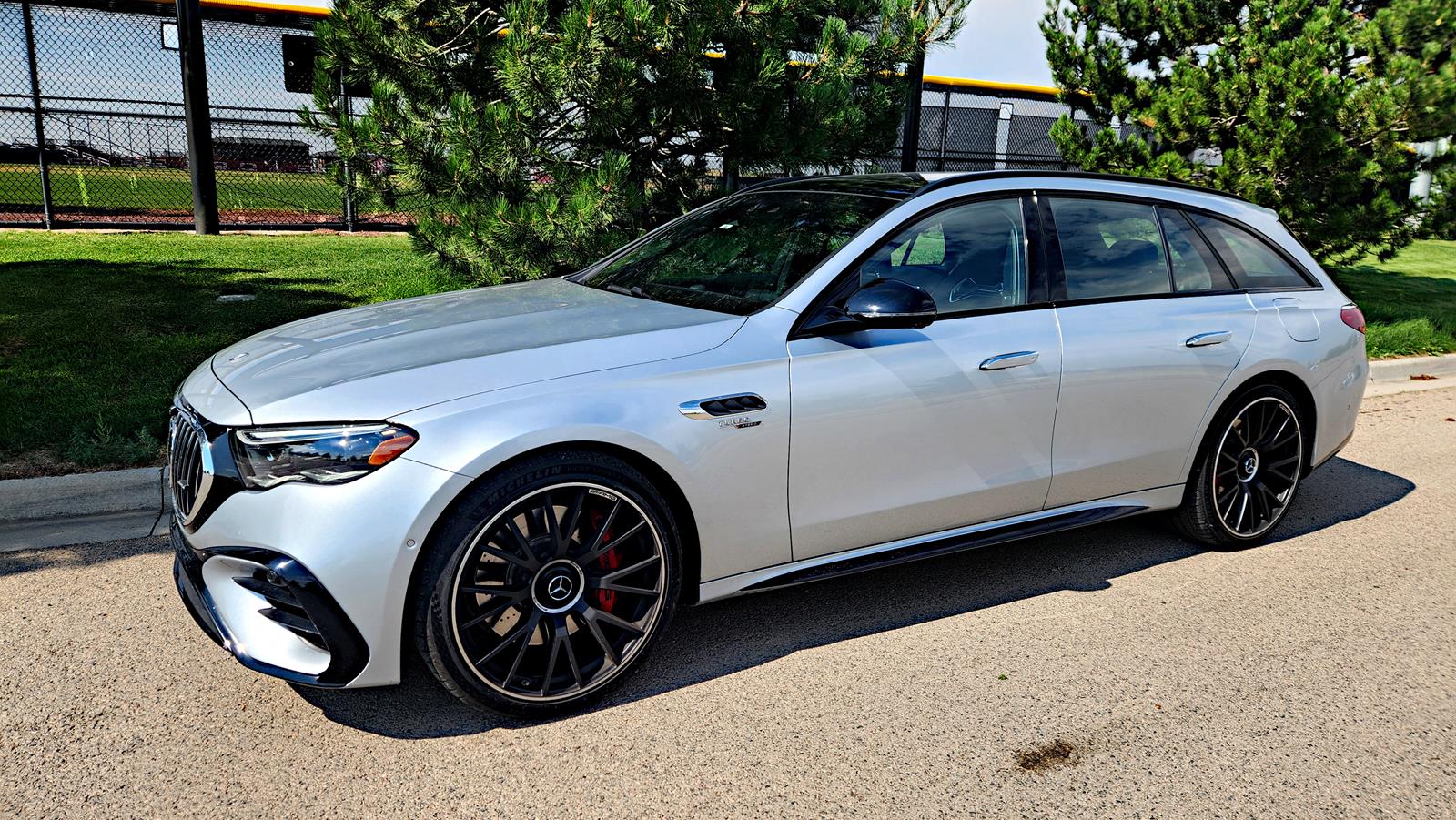
The E53’s exterior styling strikes a balance between executive transportation and performance machinery. AMG-specific details give it a more aggressive appearance than an ordinary E-Class, including distinctive front-end styling, larger wheels, performance-oriented bodywork, and exhaust outlets that announce its intentions without requiring a theatrical entrance.
It isn’t as visually outrageous as some high-performance rivals. The restrained approach also suits the car’s dual personality. The E53 can spend the morning carrying clients to a business meeting and the afternoon accelerating enthusiastically along a deserted stretch of highway.
Both activities are easier when the car doesn’t look like it escaped from a track-day paddock.
The Price of Sophistication
The E53’s biggest obstacle is its price. The 2026 sedan starts at roughly $90,000, with destination charges and optional equipment adding to the total. Performance packages, upgraded wheels, additional interior equipment, and driver-assistance technology can push the price considerably higher.
That’s a lot of money for a sedan, even one capable of producing more than 600 horsepower under the right conditions. It also raises an important question: Does the E53 offer enough character to justify its position?
The answer depends on what the buyer wants.
Someone seeking maximum performance for every dollar may find alternatives worth considering. Buyers who want a luxury interior, substantial acceleration, all-wheel-drive traction, and the ability to commute on electricity will find the E53’s combination more compelling.
Complexity is another consideration. Combining a turbocharged engine, electric motor, high-voltage battery, sophisticated transmission, and adaptive chassis systems creates an impressive machine, but also one with more systems to maintain over the long term.
That doesn’t make the E53 inherently unreliable. It simply means that buyers should understand what they’re purchasing.
A Very Fast Compromise
The 2026 Mercedes-AMG E53 is an impressive demonstration of how electrification can enhance a traditional performance sedan.
Its plug-in hybrid powertrain delivers abundant power, useful electric range, and effortless acceleration. The adaptive chassis hardware helps manage the car’s substantial weight, while the cabin provides the comfort and technology expected of a modern Mercedes-Benz.
There are compromises. The braking experience could be more consistent, the infotainment system sometimes prioritizes digital novelty over straightforward usability, and the car’s weight prevents it from feeling as naturally nimble as a smaller sports sedan.
The price also demands serious consideration.
But the E53’s central appeal is difficult to dismiss. It can travel to work quietly on electricity, cruise comfortably across several states, and deliver genuine performance when a suitable road appears.
It doesn’t require owners to choose between luxury, efficiency, and speed. Instead, it attempts to provide all three in one sophisticated package.
That makes the E53 less of a traditional AMG bruiser and more of a modern performance all-rounder.