

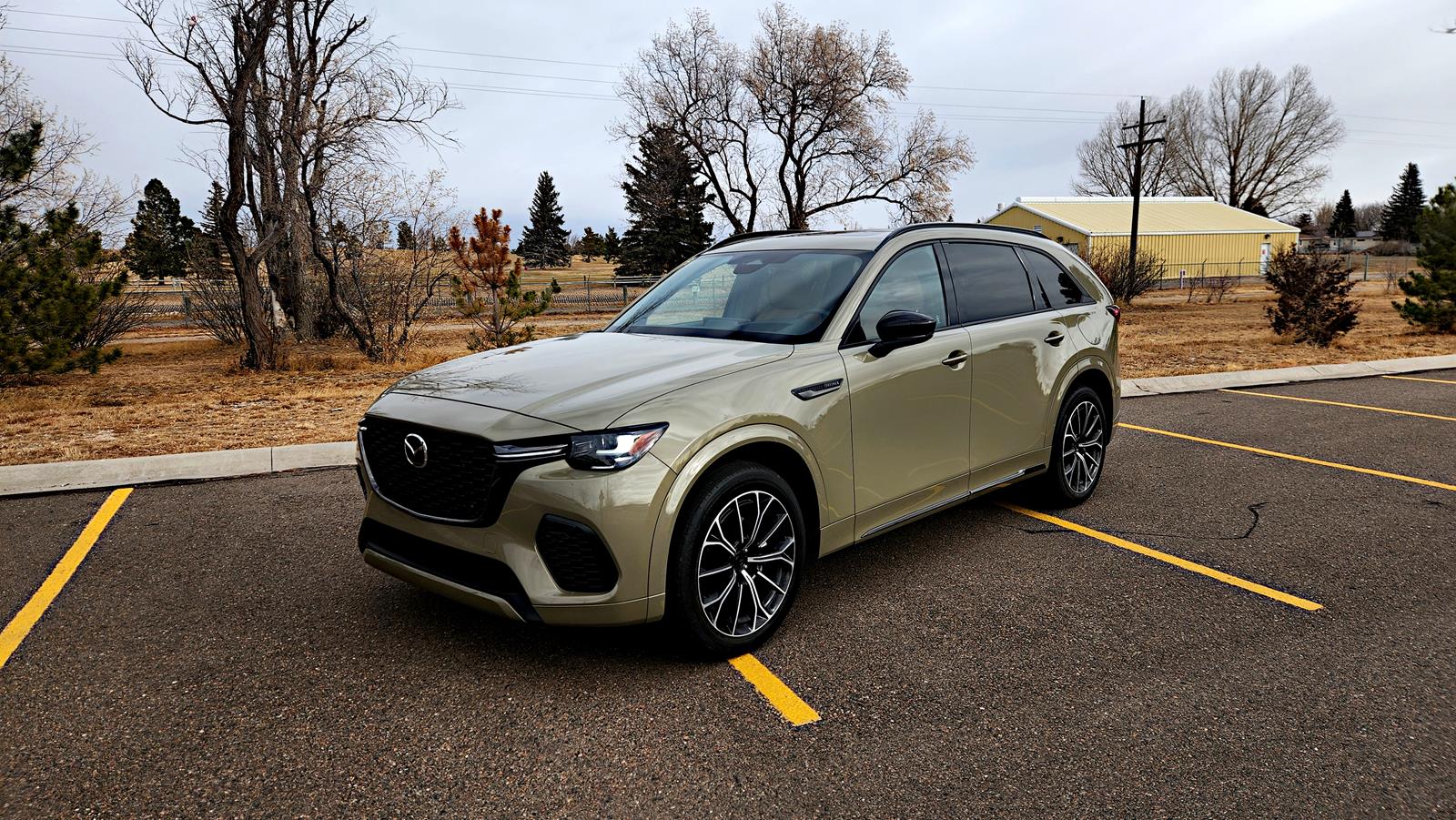
Mazda’s push upmarket has been gathering momentum for a few years now, and the 2026 Mazda CX-70 might be the brand’s most obvious proof yet that it’s serious about competing with entry-luxury crossovers. Slotting alongside the three-row CX-90 but without the extra seats, the CX-70 is a two-row midsize SUV built around the same rear-biased architecture and upscale ambitions as its larger sibling.
The result is a vehicle that feels less like a mainstream family crossover and more like Mazda trying to build a sort of BMW-lite.
The CX-70 is essentially a CX-90 without the third row. Same platform, same wheelbase, same engines. What changes is the mission. By removing the extra seating, Mazda positions the CX-70 as a sportier, more lifestyle-focused SUV with more cargo flexibility and a little more personality.
Behind the second row, cargo space opens to about 39.6 cubic feet, expanding to roughly 75 cubic feet with the seats folded. That’s excellent for a two-row SUV and easily swallows bikes, camping gear, or a week’s worth of family cargo. It’s useful cargo, not just big numbers to impress on paper. Mazda clearly intends this vehicle to appeal to buyers who want utility but don’t need seven seats.
Mazda offers two very different approaches under the hood. The headline option is a 3.3-liter turbocharged inline-six, producing either 280 horsepower or 340 hp and up to 369 lb-ft of torque depending on trim. The engine is paired with an eight-speed automatic and a mild-hybrid assist system within Mazda’s Skyactiv-G setup.
For buyers chasing efficiency, there’s also a plug-in hybrid (PHEV) pairing a 2.5-liter four-cylinder with an electric motor for a combined 323 horsepower and about 32 miles of electric-only range.
Both setups send power through Mazda’s i-Activ all-wheel-drive system.
The inline-six is the enthusiast’s pick. Smooth, quiet, and surprisingly muscular for a family crossover, it gives the CX-70 a relaxed but confident surge when accelerating onto highways or climbing mountain grades.
Driving Dynamics, Interiors Remain Mazda’s Secret Weapon
Even in SUV form, the CX-70 carries the brand’s familiar “Zoom Zoom” DNA: responsive steering, a balanced chassis, and a rear-biased AWD setup that makes the vehicle feel planted in corners. It doesn’t pretend to be a sports car, but it does feel more composed and connected than most midsize crossovers. Where many SUVs isolate the driver, the CX-70 encourages engagement.
This means that ride quality leans slightly firm compared to something like a Toyota Highlander, but it pays off with less body roll.
Step inside and the CX-70 makes Mazda’s premium-level ambitions obvious. Materials are upscale, with stitched leather, real metal trim, and layered dashboard textures that feel closer to Acura or Lexus than typical mainstream brands. The design is restrained and elegant rather than flashy.
Technology includes a 12.3-inch infotainment display, wireless smartphone integration, Alexa built-in, and a full suite of driver-assist systems. The catch? Mazda still relies heavily on a rotary controller interface instead of a fully touch-based system, which can feel a little dated compared to competitors’ more intuitive setups.
Surprisingly Efficient, Practical, and Cheap
Fuel economy varies depending on powertrain, of course. The turbo inline-six returns about 25 mpg combined, which is respectable for the power on tap and the size of this SUV.
The plug-in hybrid is the efficiency champion, capable of daily commuting on electricity alone and reaching roughly 61 MPGe when gas and electric power are combined.
That flexibility gives the CX-70 a practical advantage for buyers who want performance but still care about fuel costs.
For 2026, pricing starts around $43,780 and climbs to roughly $58,200 for the top Turbo S Premium Plus trim. Destination fees will add to that, of course. Mazda also reworked the plug-in hybrid lineup this year, significantly lowering its entry price by over $10,000 compared to the previous model year.
The 2026 Mazda CX-70 feels like Mazda’s interpretation of a premium sport-utility vehicle. It delivers a refined cabin, one of the smoothest six-cylinder engines in the segment, and driving dynamics that remain a step above the average family crossover.