

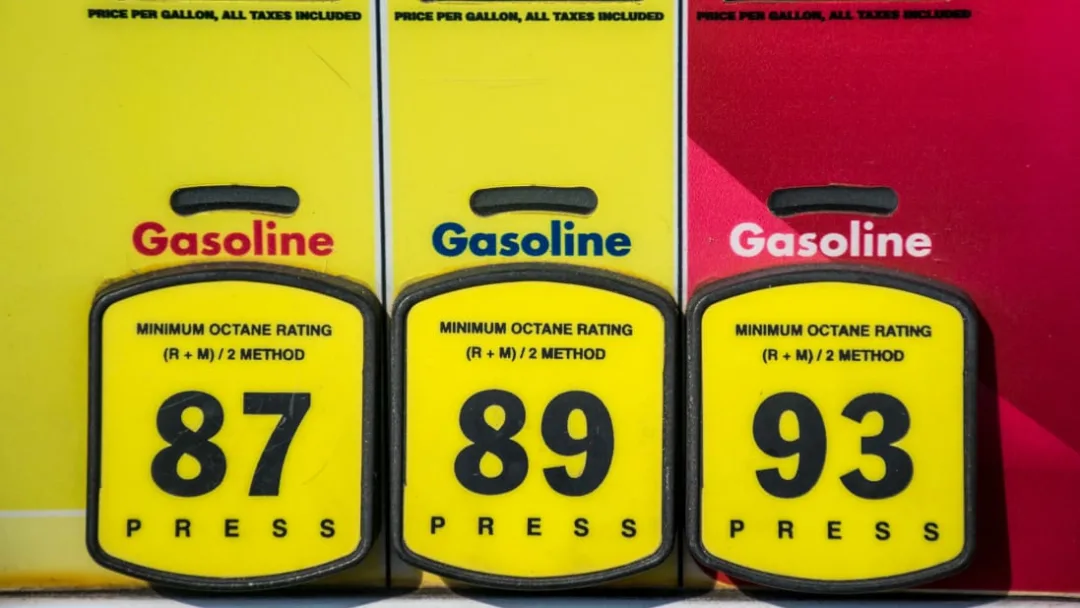
When you pull up to the gas station, you might notice different fuel grades labeled with numbers like 87, 89, or 93. Unless you own a high-performance sports car, you probably stick to the lowest and cheapest option without much thought. But what exactly is an octane rating? How do these different grades of gasoline differ, and how do they affect your car’s performance?
In North America, gasoline is typically offered in three octane ratings:
- 87 (regular)
- 89 to 90 (mid-grade)
- 91 to 94 (premium)
In some high elevation areas, 85 octane fuel is sold because engines require more volatile fuel due to thinner air. This is, however, mostly for older carbureted engines and is being phased out.
Octane ratings measure a fuel’s resistance to engine knock caused by uneven combustion. Higher octane fuels prevent knocking in high-compression engines but don’t increase power in engines designed for lower octane. Octane is determined by comparing fuel blends to reference mixtures. Historically, lead additives were used but phased out due to health risks. Today, ethanol is the primary octane booster.
What is Octane Rating?
In simple terms, a fuel’s octane rating measures its ability to resist engine knock. Engine knock is a phenomenon caused by uneven combustion inside the engine cylinder. The higher the octane level, the less combustible the fuel is.
In a typical four-stroke petrol engine, a mixture of fuel and air is injected into the cylinder and compressed by the rising piston. At the top of the piston stroke, a spark plug ignites this compressed mixture, creating hot, high-pressure gas that pushes the piston downwards.
Sometimes the fuel can spontaneously ignite at other spots in the cylinder before the spark plug fires, causing uneven combustion. This results in a loud knocking or pinging sound. This knocking, also known as detonation, is faster and more violent than regular combustion, causing rapid pressure spikes inside the cylinder.
Knocking can result from factors such as cylinder geometry and hot spots in the engine. The most common cause is fuel that is too volatile and prone to spontaneous ignition.
If unchecked, engine knock can cause serious damage and eventually engine failure.
Important Clarifications
- Octane rating does not indicate the actual proportion of any particular octane in the fuel.
- It does not indicate the energy density of the fuel.
- Using higher octane fuel than your car requires will not make it go faster but will cost more.
Octane Isomers
Although all octanes share the same chemical formula, their atoms can be arranged differently, creating 24 isomers. These isomers vary in volatility and susceptibility to spontaneous ignition.
The least susceptible is 2,2,4-trimethylpentane (iso-octane). The most susceptible is normal heptane. These two are used as reference fuels to determine octane ratings.
How is Octane Rating Measured?
Octane rating is measured using octane testing engines calibrated with primary reference fuels (PRFs) made by mixing iso-octane and n-heptane in various proportions.
- Iso-octane is assigned an octane rating of 100.
- N-heptane is assigned a rating of 0.
For example, a mixture of 93% iso-octane and 7% n-heptane has an octane rating of 93.
Commercial fuel samples are tested in these testing engines, and their knocking intensity is compared to PRF mixtures to find an equivalent octane rating.
Two values are obtained:
- Research Octane Number (RON)
- Motor Octane Number (MON)
These are combined in a simple formula–(RON+MON) ÷ 2– to yield the average octane rating displayed at the pump.
When Should You Use Higher Octane Fuel?
Higher octane fuels are preferred for engines with higher compression ratios, supercharging, or turbocharging. These engines squeeze more energy from the fuel but require fuel that resists knocking. Using lower octane fuel in such engines can cause knocking and damage.
Conversely, using higher octane fuel in a lower compression engine may slightly improve fuel efficiency and reduce CO2 emissions under extreme conditions like high-speed driving or towing. Otherwise, it offers little advantage.
Higher octane fuels are essential for high-compression or forced induction engines but offer little benefit for standard engines. Understanding octane ratings helps consumers make informed choices at the pump and appreciate the science behind the fuel that powers their vehicles.
