
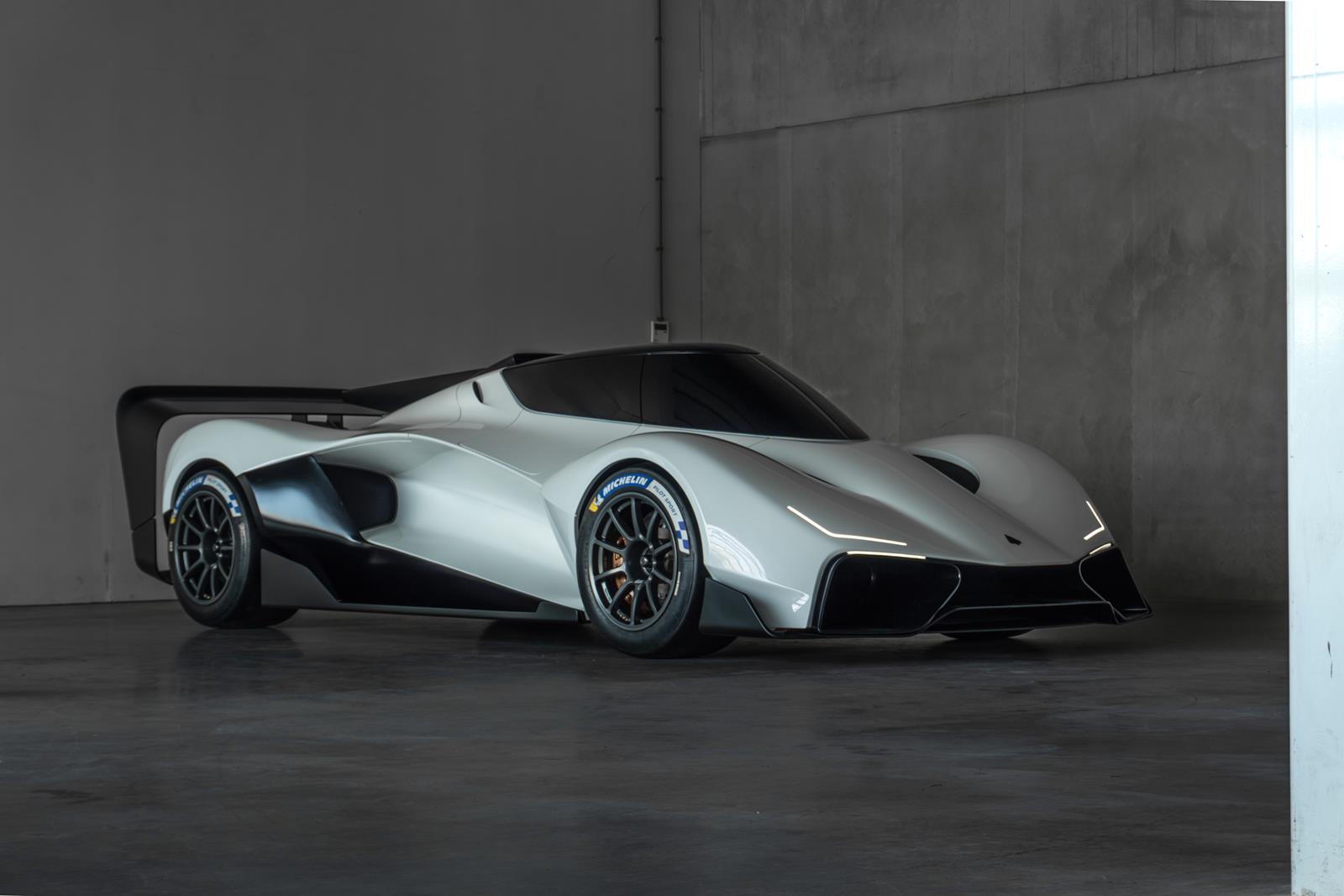
The hypercar world has a new contender, and it apparently didn’t get the memo about following established conventions. Dutch startup Sanrivatti has unveiled the ONE, a radically designed hypercar built around an unusual driver position, a naturally aspirated Judd V10, and a philosophy that puts the driving experience ahead of outright technology.
Revealed at the company’s headquarters in the Netherlands, the Sanrivatti ONE is the first complete look at the company’s debut vehicle. And while its styling looks like something that escaped from a fighter aircraft design studio, the most interesting feature might be where the driver sits.
Sanrivatti calls its approach the Apex Position, a head-forward seating arrangement intended to give drivers a more immediate connection with the road. Combined with a relatively low target weight and a high-revving V10, the ONE promises an experience that sounds considerably more old-school than most modern hypercars.
That’s not necessarily a bad thing.
A Naturally Aspirated V10 Does the Heavy Lifting
Power comes from a naturally aspirated 5.5-liter Judd V10 targeting 800 horsepower at 9,000 rpm and 700 Nm (516 lb-ft) of torque. Power goes exclusively to the rear wheels through a six-speed Hewland sequential gearbox.
In an era when hypercar manufacturers are increasingly turning to hybrid assistance, electric motors, and complicated torque-vectoring systems to chase ever-higher output numbers, Sanrivatti is taking a different route. It wants an engine that responds directly to driver inputs and delivers the sort of mechanical character that increasingly feels endangered in the modern performance-car landscape.
Judd Engines managing director John W. Judd says the engine’s appeal goes beyond its power output, emphasizing responsiveness, its character throughout the rev range, and the connection between driver inputs and vehicle performance.
The numbers are certainly ambitious. Sanrivatti is targeting a dry weight of just 1,100 kg (2,425 pounds), giving the ONE a calculated power-to-weight ratio of approximately 727 horsepower per metric tonne. Its projected top speed is 330 km/h (205 mph).
Those are impressive targets, although there’s an important distinction between targets and validated performance. The ONE is currently a show car, and its final performance specifications have yet to be established through testing.
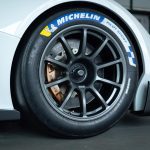
The underlying hardware includes a carbon-fiber monocoque, double-wishbone pushrod suspension with independent heave and roll, AP Racing carbon/carbon ventilated brakes, Braid forged magnesium-alloy wheels, and Michelin slick tires.
In other words, Sanrivatti isn’t pretending this is a comfortable grand tourer with a few extra aerodynamic flourishes. The ONE is being developed as a focused driver’s machine.
Inspired by Falcons and Fighter Aircraft
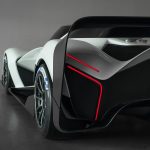
The ONE’s exterior design is certainly not shy. Led by designer Robin van Tilborg, its styling takes inspiration from the peregrine falcon in a high-speed dive and modern fighter aircraft.
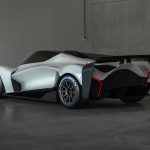
A continuous character line runs along the sides, representing the trajectory of a diving falcon. The body also features a pronounced coke-bottle shape, with broad front shoulders narrowing toward the center before expanding again around the rear wheels.
The overall appearance mixes flowing body panels with sharp intersections and angular details. It’s an unusual combination, but one that gives the car a distinctive silhouette.
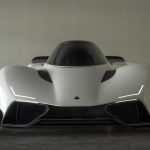
Perhaps the most dramatic feature is the single-piece canopy. Inspired by fighter-aircraft cockpits, it integrates directly into the body rather than appearing as a conventional cabin sitting on top of the chassis.
At the front, large jet-inspired intakes feed air tunnels running through the vehicle. These openings are intended to manage airflow while reducing the visual bulk of the bodywork. Slim lighting elements follow the car’s signature design lines.
The rear is similarly dramatic, with open bodywork intended to help manage airflow and engine heat. A large wing rises above the diffuser, while a smaller integrated spoiler stretches across the rear shoulders.
The result looks more like a land-based aircraft than a conventional hypercar. That’s presumably the point.
The Apex Position Changes the Driving Equation
The biggest departure from conventional hypercar design isn’t the engine or the aerodynamic treatment. It’s the driver’s seating position.
Sanrivatti’s Apex Position moves the driver farther forward and into a supported, head-forward posture. Rather than reclining behind the front axle in the familiar supercar position, the driver sits more centrally and forward in the vehicle.
The company says the arrangement takes inspiration from the physical immediacy of riding a high-performance motorcycle. It is intended to change the driver’s sightlines, control positioning, posture, and overall relationship with the vehicle.
This unusual packaging is also responsible for much of the ONE’s distinctive exterior proportions.
Sanrivatti has been developing the concept through working proof-of-concept hardware and dedicated digital and physical simulators. In comparative virtual testing at Corner Three of Silverstone Circuit, the company found that its Apex Position provided an average of 3.2 times more visible racing surface than the ten benchmark hypercars and track cars evaluated at the same location.
That’s an interesting finding, although it needs some context. The measurement concerns visible track surface in a simulation. It doesn’t demonstrate faster lap times or prove that the seating position produces better real-world driving performance.
Still, improving visibility and driver awareness is a worthwhile engineering goal, particularly in a vehicle intended for track use.
Sanrivatti is also developing proprietary body-support and control technologies intended to allow the driver to move more naturally with the vehicle while remaining supported and secure.
A New Company With Ambitious Plans
Sanrivatti first introduced itself publicly in May 2026, presenting its ambition to rethink the relationship between driver and machine. The ONE represents the first complete exterior expression of that philosophy.
Founder and CEO Santiago Sánchez Rivero grew up in Uruguay before studying automotive engineering in the Netherlands. He’s supported by an international design and engineering team, including Paul Arkesden, the company’s executive director of technology partnerships.
Arkesden brings more than three decades of high-performance automotive experience, including senior engineering roles at Singer Vehicle Design and McLaren Special Operations, along with involvement in the McLaren P1 program.
That experience will presumably come in handy. Developing a hypercar around an unconventional seating position means rethinking considerably more than the driver’s seat. Packaging, structural engineering, aerodynamics, ergonomics, and control placement all have to work together.
Sanrivatti acknowledges that considerable development and validation remain.
The unveiled ONE is a show car demonstrating the intended exterior design, proportions, and engineering direction. The company plans to continue developing its vehicle systems and specifications before moving toward a bespoke running prototype and eventual track testing.
A Hypercar That Wants to Feel Different
There’s no shortage of hypercar manufacturers promising more horsepower, more technology, and increasingly ridiculous acceleration figures. Sanrivatti is attempting to make a different argument: that the experience of driving a car can be just as important as how quickly it gets around a circuit.
The ONE’s naturally aspirated V10, six-speed sequential transmission, rear-wheel-drive layout, and relatively low weight certainly support that philosophy. The unconventional driving position adds another layer of intrigue.
Of course, a dramatic show car and an ambitious specification sheet are only the beginning. Sanrivatti still needs to turn its concepts into a functioning vehicle, validate its performance claims, and demonstrate that the Apex Position offers meaningful advantages outside a simulator.
But there’s something refreshing about a startup choosing a naturally aspirated V10 and a manual-style sequential gearbox rather than simply throwing electric motors and software at the problem.
The Sanrivatti ONE isn’t ready to challenge established hypercars on a race circuit just yet. For now, it’s an intriguing demonstration of what happens when a company decides that the driver, rather than the horsepower figure, should be the starting point.