

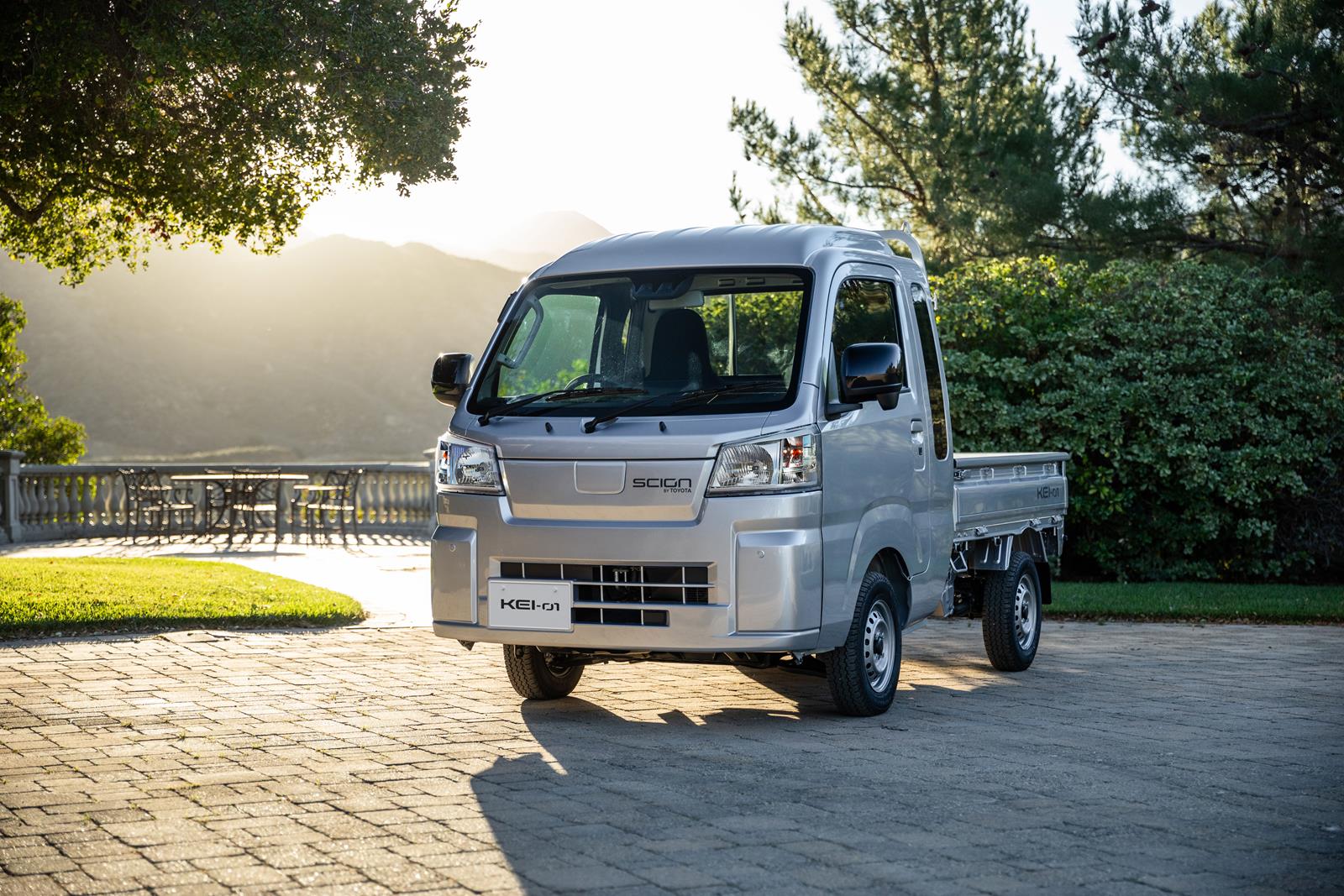
Scion is making a comeback, but this isn’t the Scion of inexpensive coupes, quirky hatchbacks and youthful marketing campaigns. Toyota is resurrecting the name as an experimental mobility brand, and its first production-intended vehicle is something Americans don’t see every day: a tiny Japanese-style kei truck.
Introduced simultaneously at events in Ypsilanti Township, Michigan, and Frisco, Texas, Scion by Toyota represents a new approach to exploring vehicle design, utility and personal mobility. The brand’s first vehicle, the KEI-01, is scheduled to arrive in the United States in the second half of 2027.
Toyota also introduced two additional concepts, the SxS Concept and BKE Concept, demonstrating that Scion’s new mission extends well beyond small utility trucks.
Scion Returns as Toyota’s Experimental Playground
Toyota describes Scion by Toyota as a “freedom lab,” a place where designers and engineers can experiment with new vehicle ideas, challenge conventional thinking and explore different approaches to mobility.
The concept builds on the experimental spirit of the original Scion brand, which Toyota launched to appeal to younger buyers interested in affordable vehicles and personalization. This time, however, the emphasis is less on attracting a particular demographic and more on exploring what vehicles can become.
According to Simon Humphries, Toyota Motor Corporation’s Chief Branding Officer and Head of Design, the future of mobility shouldn’t be limited to one vehicle, technology or way of thinking.
That’s a fairly broad mission statement, but Toyota appears willing to put some unusual ideas behind it. The three vehicles introduced with the new brand illustrate very different approaches to utility, adventure and personal transportation.
And one of them looks like it escaped from a Japanese farm equipment catalog.
KEI-01: A Tiny Truck With a Surprisingly Practical Mission
The KEI-01 is the first vehicle to emerge from Scion by Toyota, and it’s essentially an American-market interpretation of Japan’s popular kei truck concept.
These ultra-compact trucks have been working in Japan for decades, providing inexpensive, maneuverable transportation for farmers, small businesses and anyone who needs a little utility without the expense and footprint of a conventional pickup.
The KEI-01 brings that formula to the United States, although with some important limitations.
Power comes from a 660cc three-cylinder engine paired with a continuously variable transmission. Standard four-wheel drive gives it additional capability on uneven terrain, while selectable drive modes, an automatic mode and a push-button locking function help it manage mud, snow and other challenging surfaces.
The numbers aren’t exactly going to intimidate a Ford F-150 Raptor, but that’s not the point.
Measuring just over 11 feet long and less than five feet wide, the KEI-01 is designed to work in places where conventional pickups become cumbersome. Its compact dimensions should make it particularly useful around farms, warehouses, campuses and urban commercial environments.
The cargo bed features a three-way fold-down design for easier loading and unloading. Toyota says the truck can carry up to 600 pounds in the bed and is structurally designed to tow small trailers and equipment.
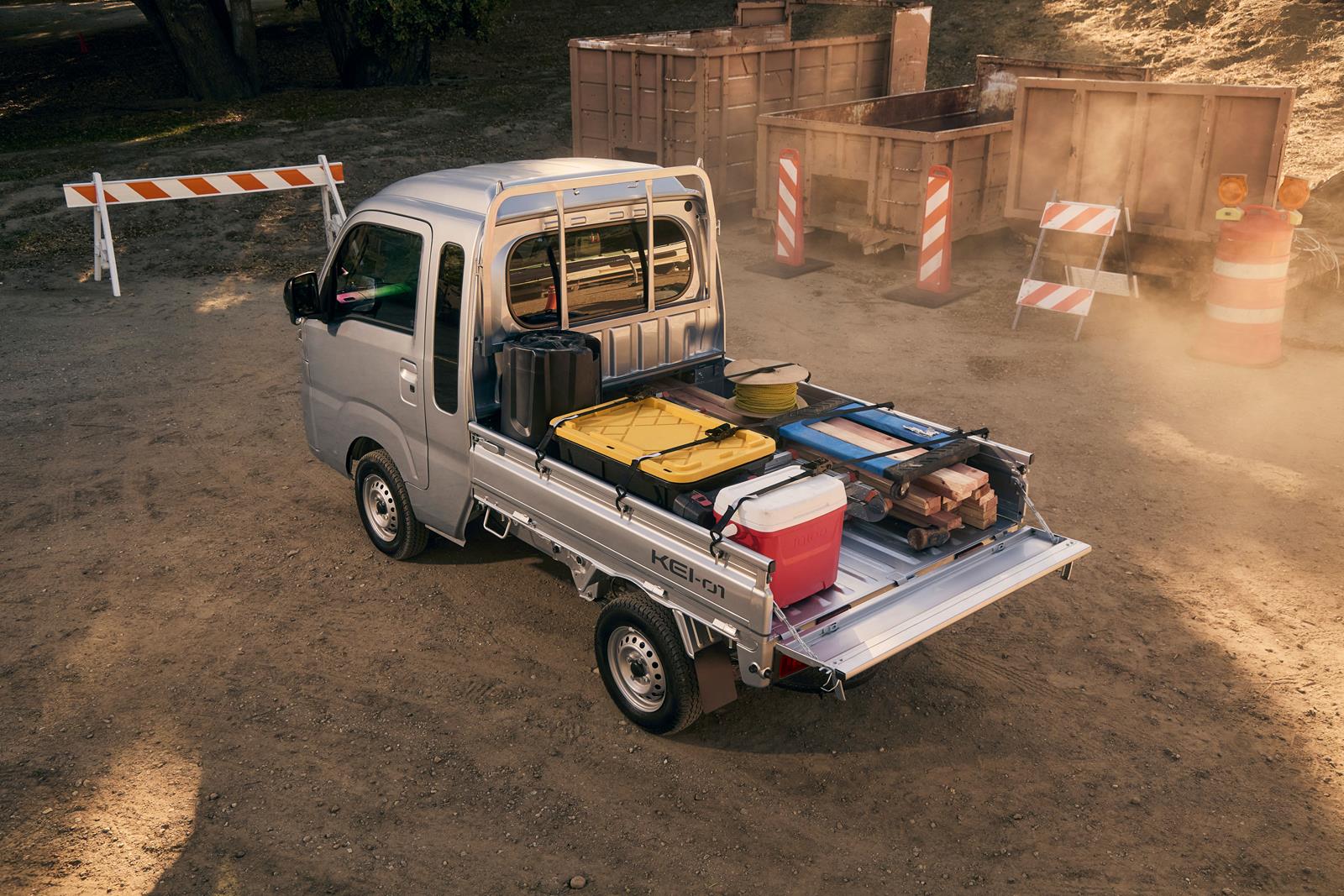
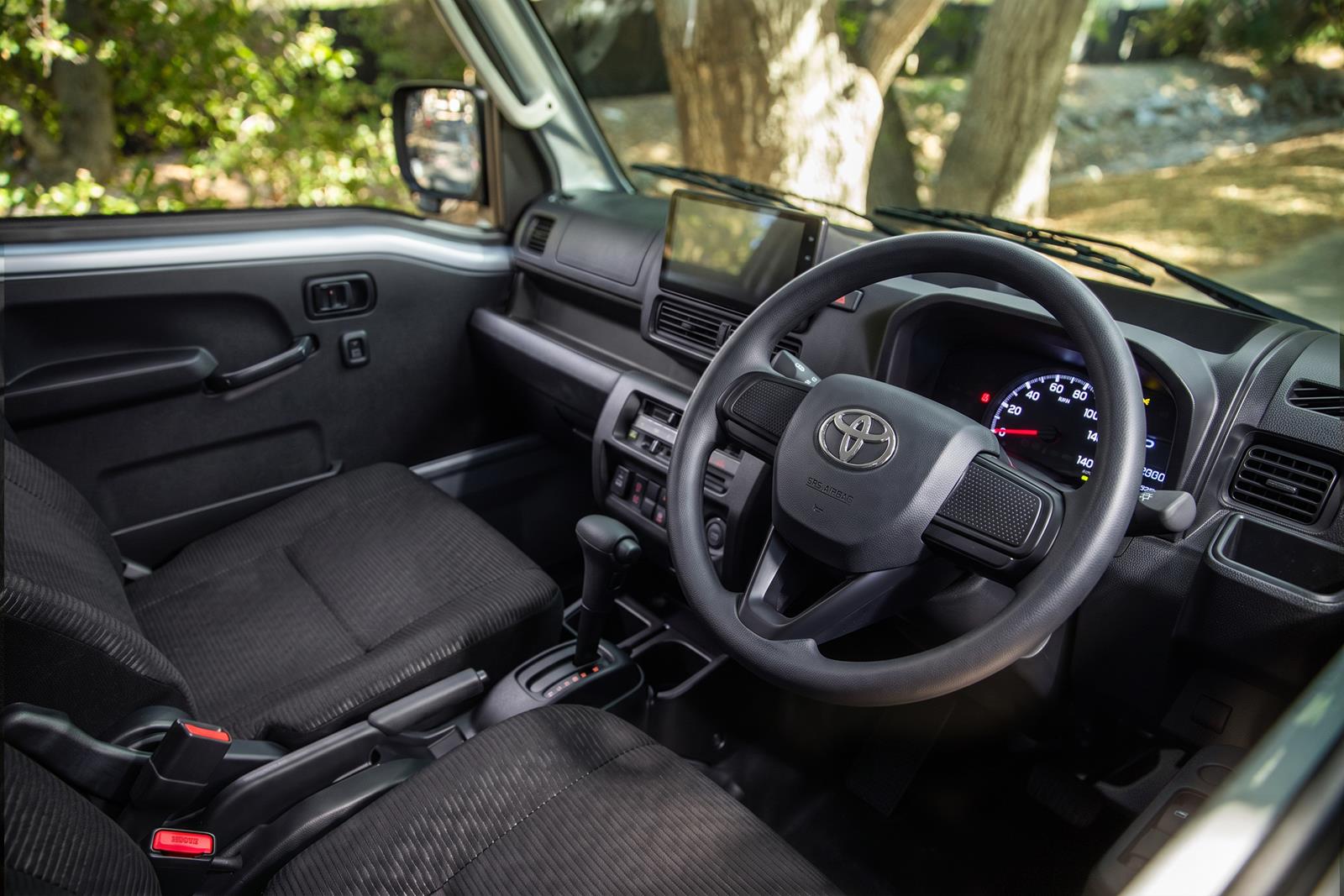
The cabin is also more accommodating than its diminutive exterior might suggest. An extended-cab configuration provides reclining and sliding seats, additional storage behind the seats, and an enclosed interior with heating and air conditioning.
In other words, this isn’t simply a golf cart with a cargo bed and delusions of grandeur.
There is, however, an important distinction between the KEI-01 and a conventional pickup. Toyota says the vehicle is designed to comply with Federal Motor Vehicle Safety Standard No. 500 requirements for low-speed vehicles (LSVs). Its maximum speed will be 25 mph, and it will be right-hand drive.
That makes its intended applications considerably different from those of a typical road-going truck.
Don’t Expect to Buy One at Every Toyota Dealer
Toyota is approaching the KEI-01 as a niche product rather than something intended for mass-market sales.
Initially, the truck will be offered through a fleet-focused pilot program. Sales will take place through selected Scion by Toyota dealers, which will be existing Toyota dealerships designated to handle the new brand.
The pilot program will allow Toyota to learn more about how American customers use the vehicle and which applications make the most sense.
Potential customers include small-business owners, farmers, ranchers, municipalities, universities, corporate campuses and delivery or service providers operating in urban environments.
Outdoor enthusiasts and hobbyists are also on Toyota’s list of potential buyers.
Whether the KEI-01 eventually becomes available for limited retail sales will depend on market conditions, customer demand and operational considerations. Toyota hasn’t announced pricing or a broader sales strategy yet.
The company is clearly taking a cautious approach, which makes sense for a vehicle that occupies such an unusual position in the American market.
Toyota Is Building the KEI-01 in Indiana
One of the more interesting aspects of the KEI-01 announcement is where the vehicle will be assembled.
Toyota plans to build the truck at Toyota Motor Manufacturing Indiana beginning in the second half of 2027. The project represents a $34 million investment and is expected to create approximately 50 new jobs.
The investment will establish new vehicle assembly operations while upgrading production and logistics infrastructure at the facility.
For a vehicle this small, the American production decision is notable. Toyota is effectively bringing a distinctly Japanese vehicle category into its U.S. manufacturing operations.
It also gives the company an opportunity to explore a segment that traditional American automakers have largely ignored.
SxS Concept: More Than 300 Horsepower in a Side-by-Side
The KEI-01 might be the practical member of the Scion family, but Toyota has something considerably more entertaining in mind with the SxS Concept.
First shown at the 2025 SEMA Show, the SxS is a purpose-built side-by-side designed for serious off-road use.
Its powertrain combines a turbocharged four-cylinder engine with hybrid technology to produce more than 300 horsepower. That’s a substantial amount of power for a compact off-road vehicle.
Toyota says the SxS was developed by its North American engineering team and designed for everything from high-speed desert running to technical rock crawling.
Significant suspension articulation and a compact footprint should help it navigate difficult terrain. It also features a Silent Mode that allows it to operate using electric power.
Toyota plans to continue developing the concept and evaluating its potential as an entirely new off-road experience.
Considering the popularity of high-performance side-by-sides, a hybrid-powered machine with more than 300 horsepower could be an interesting addition to the market.
Of the three Scion vehicles introduced, this is probably the one most likely to get enthusiasts paying attention.
BKE Concept: Exploring Different Kinds of Mobility
The third vehicle, the BKE Concept, takes a different approach.
Rather than concentrating on traditional utility or high-performance off-road capability, the BKE explores compact personal mobility and outdoor adventure.
Toyota describes it as a highly adaptable vehicle designed to accommodate different lifestyles, activities and experiences.
The BKE occupies something of a middle ground between the KEI-01’s practical utility and the SxS Concept’s off-road performance. Its purpose is to explore new ways people might move through and experience the outdoors.
Toyota hasn’t provided detailed mechanical specifications or production plans for the BKE. For now, it serves as an example of the kind of experimentation Scion by Toyota is intended to encourage.
A Different Kind of Scion
The original Scion brand eventually disappeared, but its emphasis on unconventional designs, affordability and personalization left an impression on Toyota’s American operations.
Scion by Toyota appears to be taking that philosophy in a different direction. Rather than simply creating another lineup of small passenger vehicles, Toyota is using the name to explore mobility ideas that don’t necessarily fit neatly into existing product categories.
The KEI-01 is the most tangible example of that approach. It takes a proven Japanese utility vehicle concept and adapts it for a very specific group of American buyers.
The SxS Concept explores the possibilities of hybrid performance in off-road recreation, while the BKE looks at entirely different forms of personal mobility.
None of this means Toyota is about to start selling a full lineup of strange little trucks and recreational vehicles at every dealership. The company is deliberately positioning Scion as an experimental operation, with concepts and potential products evolving as it learns what customers want.
Still, the KEI-01 is an intriguing first step. A tiny, four-wheel-drive, air-conditioned utility truck assembled in Indiana isn’t something most Americans would have predicted from a revived Scion brand.
And perhaps that’s exactly the point.
