

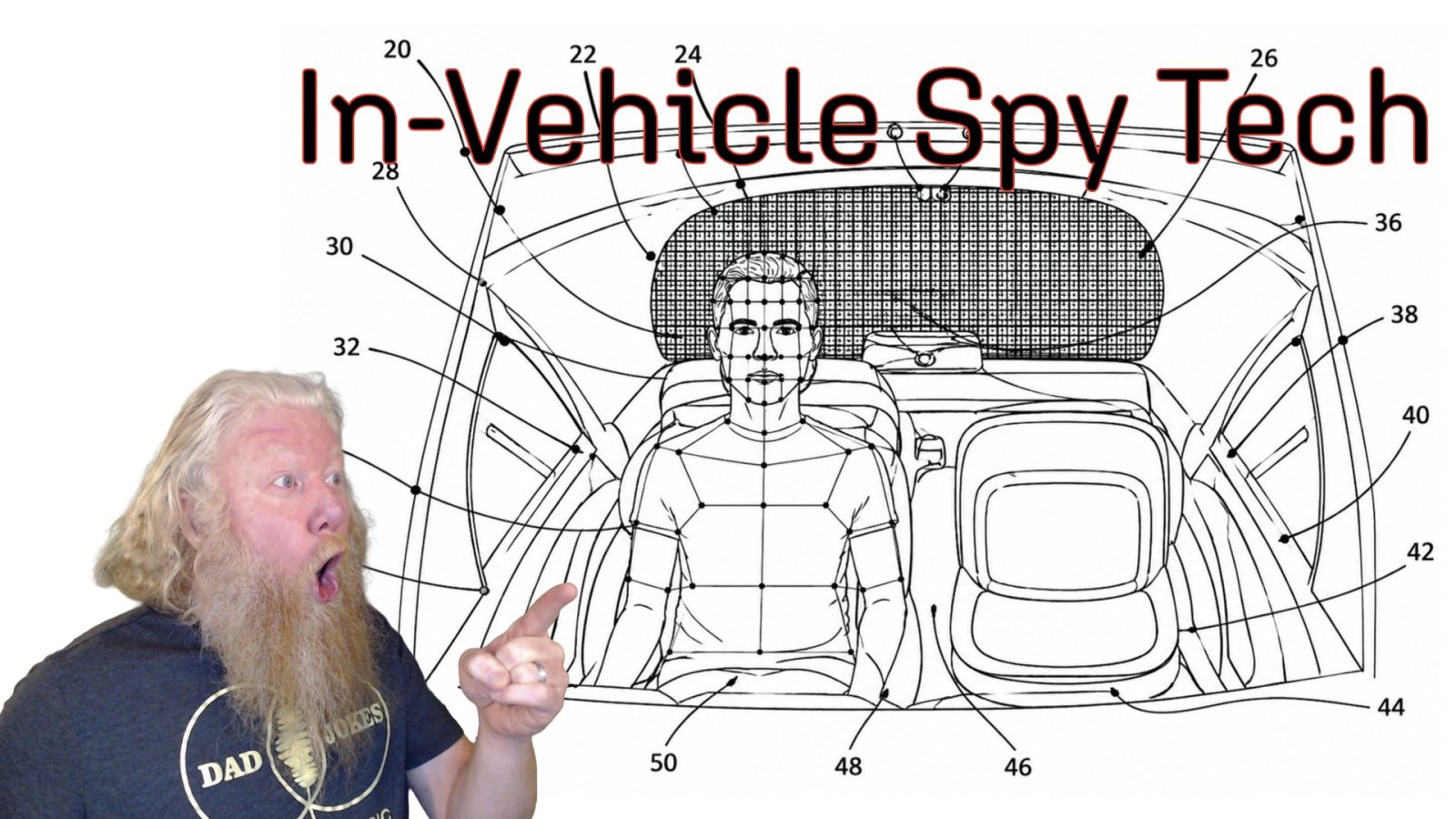
Imagine an emergency situation and you need to rush to respond. You run to your truck, but the vehicle refuses to shift into drive. Why? Because the truck’s internal cameras and sensors detect and interpret your emotional state. Your wide eyes, panic, and stress are determined to mean that you are not fit to drive.
This scenario is becoming a reality. Ford has filed patents for such technology. And others aren’t ignoring it.
Ford has submitted a series of patents to the U.S. Patent and Trademark Office that describe trucks equipped with advanced sensors and cameras inside the cab. These systems monitor the driver’s biometric data, including facial expressions, iris scans, fingerprints, and even lip movements. If the system determines the driver is unfit, it can prevent the vehicle from shifting from park to drive. These will be marketed as safety equipment, but there is a lot more going on. As the patents themselves reveal.
One of Ford’s patents (serial number 0104469) details a system that runs the driver’s biometric data through a criminal database in real time. This means that when you enter your own truck or SUV (a vehicle registered in your name and possibly on your own property) the vehicle scans your face and other biometric identifiers and checks them against law enforcement databases before you even start driving. And potentially notifies police if it finds a match. A match using criminal facial recognition that has proven to be iffy at best in the real world.
Ford explicitly states in their patent that this technology could be useful for police, effectively turning your personal vehicle into a surveillance tool. Likely without your knowledge or consent.
It doesn’t stop there.
The technology goes beyond visual monitoring. Ford’s patents describe cameras trained with machine learning to read lip movements, connected to the cloud for processing and storage. Additionally, the system emits inaudible sound waves to analyze echoes from your mouth, enabling acoustic lip reading without your awareness. Why?
Well, Orwell aside, more modern science fiction movies have predicted this. It’s for advertising. Yep, that thing I bring up all the time. You know how it is when you talk about something you saw or thought of and suddenly your phone starts popping up ads for that thing? Like that, but with your car.
But beyond that annoying “ads are everywhere” idea, there’s another concerning feature: the system’s ability to listen to conversations inside the cab. Remember that law enforcement thing I mentioned a couple of paragraph earlier? Exactly.
And there is no clear information on how this sensitive data is protected. It’ll probably be protected about as well as most of the data collected by your phone is. Meaning it’ll be protected against thievery by those who don’t have contracts with Ford.
Ford already offers a product called Ford Pro Telematics, which allows fleet managers to access live in-cabin video feeds of drivers via their phones. This system also provides seat belt compliance alerts, marketed as a way to reduce insurance costs. That’s all well and good, since those are fleet-owned vehicles being used by employees who are on the clock and for whom the company would be responsible. But that was clearly just a first step.
The underlying issue is data ownership and liability. Although you may own the truck, the data generated by these monitoring systems belongs to Ford and its partners. Insurance companies and law enforcement can potentially (and explicitly, given the patents’ wording) access this data through agreements, not necessarily requiring court orders.
Ford is not alone in this technological arms race. Driver monitoring software from third party companies are already installed in vehicles worldwide. The European Union mandates drowsiness detection systems as standard safety equipment. And Ford has experimented with, while General Motors has introduced, biometric seat sensors and heart rate monitoring in production trucks. Tesla has also incorporated cabin AI stress detection. In 2025, a European conference discussed real-time cardiac data monitoring from in-cab cameras.
Interestingly, the EU has banned emotion recognition AI in workplaces and schools, citing violations of fundamental rights and labeling it pseudoscience. However, the same technology is permitted in vehicles under the guise of safety, highlighting a regulatory loophole.
Safety features like seat belt interlocks that prevent shifting the transmission if the seat belt is not fastened or doors are open are already present in GM and Ford and other manufacturer’s vehicles.
We have the Fourth Amendment, though. Right? Well, this only protects against unreasonable searches, but the loophole is twofold. By agreeing to the terms of service when activating connected features, drivers may unknowingly waive these protections. And those protections don’t limit private entities, only the government. The technology is designed so that you cannot operate the vehicle without consenting to this surveillance, so you’ll either agree or not have the vehicle.
Ford’s motivation is not purely safety. As I’ve said before, data has become the product. The vehicle you buy merely serves as a subscription model where drivers pay with their personal data. The infrastructure for monitoring is in place, and once established, it is likely to be used and abused.
The future of vehicle ownership is shifting. While you may have your name on the title and have paid for your vehicle, the control and data generated by it increasingly belongs to manufacturers and third parties. Advanced biometric monitoring systems can restrict your ability to drive based on emotional or biometric assessments, collect sensitive data for insurance and law enforcement, and monetize your personal information.
As these technologies become more widespread, it is crucial to consider the implications for privacy, autonomy, and rights. The question remains: when you buy a car, truck, or SUV, do you truly own it, or has control shifted to those who hold the data and the technology?
This article originally published on the AaronOnAutos Substack.
