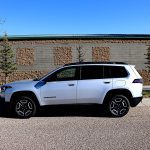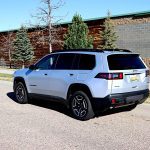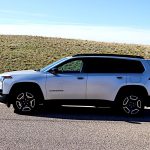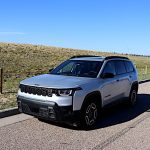

There was a time when the Jeep Cherokee sat comfortably in the middle of Jeep’s lineup like a dependable middle child. It was less flashy than the Wrangler, less suburban than the Grand Cherokee, and just rugged enough to keep the brand’s trail-rated reputation intact. Then it disappeared. Now it’s back for 2026 and, like many returning celebrities, it’s undergone a bit of a reinvention during its three year hiatus.
This time around, the headline act is electrification.
The 2026 Cherokee Hybrid aims to bridge the gap between off-road credibility and the modern need to sip fuel like it’s a rare bourbon. The question, of course, is whether it actually does that or if it’s just another electrified SUV trying to cosplay as something more adventurous than a mall crawler.
Do mall crawlers still exist? Malls aren’t really a thing anymore. Maybe now they are “box store crawlers” instead. That doesn’t have the same ring. Anyway..
Familiar shape, modernized intent
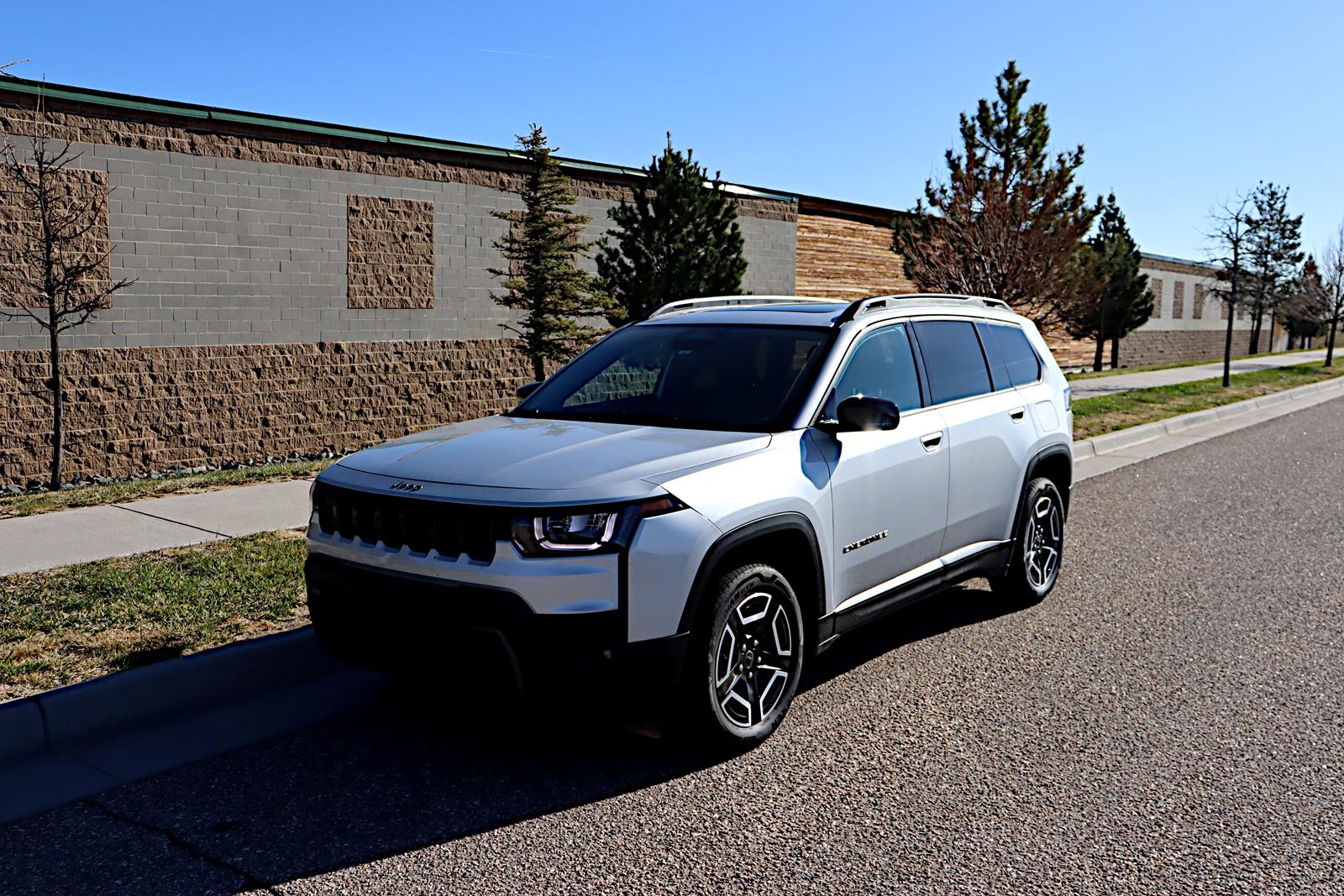
Visually, the new Cherokee doesn’t stray too far from Jeep’s design playbook. You get the signature seven-slot grille, hexed wheel arches, and a stance that suggests it at least knows what dirt looks like, whether it actually goes on it or not.
It’s a cleaner, more mature look overall. Less “weekend warrior” and more “weekday commuter who owns hiking boots.” Whether that’s a good thing depends on your expectations. If you want something that screams Moab, you’re still better off with a Wrangler. The Cherokee just sort of casually mentions it instead.
Hybrid power is the new trail badge
Under the hood (and the floor, to be technically correct), the Cherokee Hybrid pairs a 1.6-liter turbocharged, four-cylinder gasoline engine with electric motors, a continuously variable transmission (CVT), and a battery pack large enough to enable meaningful all-electric driving. Expect something in the neighborhood of 12-15 miles of electric range most of the time. All-wheel drive is standard and towing is rated at 3,500 pounds. All told, the Cherokee Hybrid produces 210 horsepower and 230 pound-feet of torque.
Around town, that means you can run errands, commute, and quietly judge your neighbors without burning much, if any, fuel. On the highway, the engine does most of the work. For the most part, it’s a good compromise between a full battery-electric option with limited range and a gas-only option with limited fuel economy. Expect around 37 mpg most of the time out of the Cherokee Hybrid. I was able to get that in my week with it and that’s what the EPA says it should be doing. So kudos to Jeep there.
The real trick here is how the hybrid system integrates with Jeep’s off-road DNA. Electric motors deliver instant torque, which is great for crawling over rocks or navigating uneven terrain. In theory, this makes the Cherokee Hybrid more capable off-road than its purely gasoline predecessors. In practice, it depends on how willing you are to take the Cherokee into places where scratches are inevitable and tow trucks are theoretical. I doubt most new SUV buyers are actually willing to do that.
On-road manners are disapointingly civilized
If you’ve driven older Cherokees, you might remember a ride quality that could, if being nice, be described as “confidently firm.” Even the outgoing 2023 model Cherokee was pretty stiff with a lot of body roll. The 2026 model tones that down. A lot. The hybrid setup adds weight, but it also adds refinement. Electric driving is smooth and quiet, and transitions between electric and gasoline power are largely seamless.
Steering is light but precise enough for daily driving, and the suspension leans toward comfort rather than corner-carving enthusiasm or off-road bounce. This is a commuter-first vehicle that happens to have a passport for (light) off-road adventures.
And honestly, that’s probably the right call. Most Cherokees will spend their lives navigating traffic, not trails. The hybrid system makes that experience significantly more pleasant and cheaper at the pump.
Interior become tech-forward
Inside, Jeep has clearly taken notes from competitors. The cabin is dominated by a large central touchscreen running the latest Uconnect system, paired with a digital instrument cluster. Wireless everything is standard (Apple CarPlay, Android Auto, charging pads) because it’s 2026 and cables are now considered a red flag.
Materials are a step up from past generations, with softer surfaces and more thoughtful design throughout. There’s still a hint of ruggedness in the layout, but it’s tempered by a clear desire to feel upscale enough to justify the price tag that inevitably comes with electrification.
Passenger space is solid for the segment, and cargo capacity remains practical, though the battery pack does nibble away at some underfloor storage. That’s the tax you pay for plugging in.
Here’s an interior walkthrough:
The reality check
Here’s the part where we inject a little realism.
The Cherokee Hybrid is more expensive than its gas-only predecessor and thus more expensive than its non-hybrid competitors. Fuel savings and maybe some tax incentives (where applicable) help offset that, but it’s still a premium proposition.
There’s also the question of identity. Is this a rugged off-roader with a hybrid system, or a hybrid commuter with rugged styling? The answer is “yes,” which is both its strength and its weakness.
The 2026 Cherokee Hybrid feels like Jeep acknowledging that the world has changed and deciding to adapt rather than dig in its heels. It’s more efficient, more refined, and more technologically relevant than the Cherokee that came before it. At the same time, it hasn’t completely abandoned what made the nameplate matter in the first place. There’s still a sense of capability here, even if most owners will never fully exploit it.
In the end, the new Cherokee Hybrid doesn’t try to be everything to everyone, but instead it just tries to be enough for most people. So don’t be surprised if the most off-roading it sees is a gravel driveway. But hey, at least it’ll get there using electrons.
The 2026 Jeep Cherokee Hybrid starts at about $37,000 after destination fees. The version I drove had a window sticker at about $46,000.