

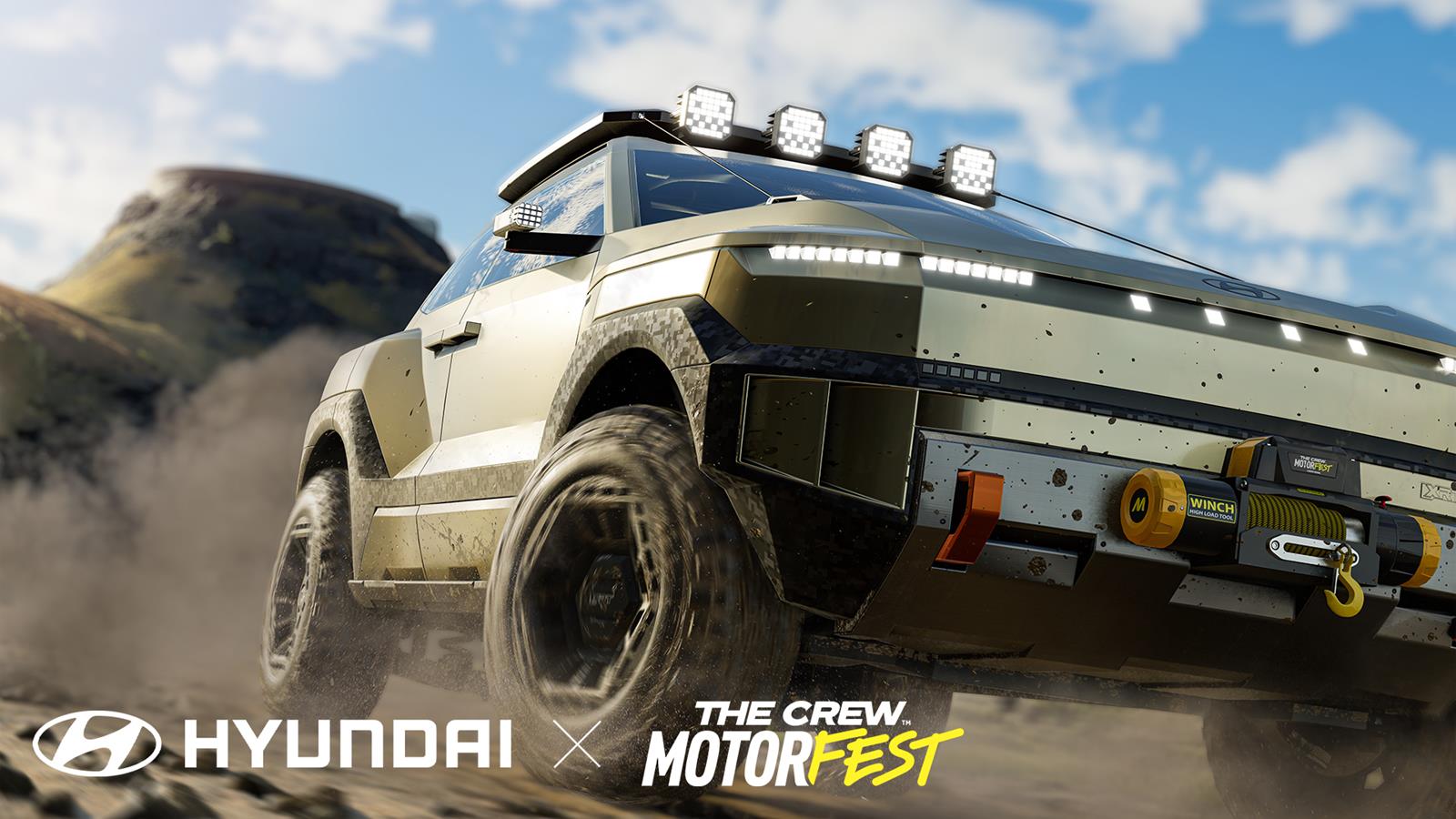
Hyundai is taking its latest off-road concept somewhere it can do things the real-world version can’t: straight into a video game.
The automaker announced that its CRATER Concept has officially joined Ubisoft Ivory Tower’s open-world racing game The Crew Motorfest. The digital debut puts Hyundai’s compact electric off-roader into a virtual playground filled with roads, trails, jumps and enough automotive nonsense to make an engineer nervous.
It also gives Hyundai another way to introduce its growing XRT off-road design philosophy to a younger, gaming-focused audience.
Because apparently the modern car-buying journey now includes test-driving something that doesn’t technically exist.
A Digital Off-Roader With Real-World Intentions
The CRATER Concept is a compact off-road electric SUV concept developed at Hyundai America’s Technical Center (HATCI) in Irvine, California.
Hyundai designed it around exploration, ruggedness and the idea that an electric SUV doesn’t have to look like it spends its entire life parked outside a Whole Foods.
The concept represents the next evolution of Hyundai’s XRT design direction. XRT is the company’s off-road-oriented trim level in the U.S., offering more aggressive styling and additional capability compared with standard models. Hyundai has also begun expanding the formula with XRT PRO variants that take the concept further into serious off-road territory.
The CRATER Concept takes that philosophy and turns the volume knob considerably higher.
It has the chunky, purpose-built appearance expected of an off-road machine, while its electric powertrain gives Hyundai a way to explore what a rugged EV could look like.
Whether any of that translates directly into a production vehicle remains a different question. For now, CRATER is a design and technology statement—and a rather convenient digital ambassador for the XRT family.
Why Put It in a Video Game?
Hyundai’s reasoning is fairly straightforward.
People don’t experience cars exclusively by walking into dealerships anymore. They see them on social media, in movies, through influencers and increasingly inside video games.
The Crew Motorfest is particularly well suited to the CRATER Concept because it isn’t merely a traditional circuit-racing game. Players can explore a large open world inspired by real locations, participate in different automotive activities and interact with vehicles in ways that extend beyond simply trying to finish first.
That makes an off-road concept a pretty natural fit.
Hyundai says the collaboration is intended to let players experience the adventurous character of CRATER while also getting a taste of where the company’s XRT design language is heading.
And unlike a traditional auto show, nobody has to worry about accidentally scraping a concept’s expensive wheels against a concrete barrier.
CRATER Gets a New Trick
Hyundai’s virtual version of the CRATER Concept isn’t simply a digital model dropped into the game.
The Season 11 off-road update introduces a new winch feature that allows players to deal with obstacles and difficult terrain. Players can use the winch to recover their vehicle when things go wrong, but they can also pull obstacles out of their way.
That’s a particularly appropriate feature for CRATER.
In the real world, getting stuck while exploring an off-road trail generally results in someone standing outside the vehicle wondering why they thought this was a good idea. In The Crew Motorfest, players can apparently solve the problem with a virtual winch and continue their adventure.
The game also allows players to customize CRATER to suit their preferred off-road style.
That customization extends into the game’s Custom Show community feature, where players can display their creations. TrackForge also allows players to build and share their own courses, opening the door to custom off-road challenges specifically designed around the Hyundai.
Influencers Get Involved
Hyundai and Ubisoft Ivory Tower are also bringing gaming influencers into the collaboration.
The partnership includes in-game vehicle reviews focused on CRATER’s off-road design, a custom course created specifically for the concept using TrackForge, and live races in which players can compete against influencers.
It’s a clever way of turning what could otherwise be a simple product placement into something players can actually interact with.
Instead of saying, “Hey, look at our new concept,” Hyundai is effectively saying, “Here’s the truck. Here’s a trail. Now go break something.”
Virtually, of course.
XRT Is Becoming a Bigger Deal
The CRATER Concept is also part of a broader push by Hyundai to establish XRT as a recognizable off-road sub-brand.
The company originally introduced XRT in the U.S. market as a more rugged alternative for customers who wanted something tougher-looking and more adventure-oriented. Hyundai has continued expanding the idea, including the more capable XRT PRO treatment.
The recently unveiled TUCSON XRT PRO is the latest example of that strategy.
CRATER takes the idea even further by imagining what the XRT philosophy could become when designers aren’t constrained by production requirements, crash standards, manufacturing costs or the inconvenient presence of gravity.
That’s one of the great advantages of concept vehicles—and video games.
Hyundai’s Growing Gaming Presence
The Crew Motorfest collaboration isn’t Hyundai’s first trip into the virtual world.
The automaker launched its first official experience on Roblox in 2021 and has since expanded into other major gaming platforms, including Fortnite, Rocket League, Top Eleven and Asphalt Legends.
Hyundai has also used gaming partnerships to connect its products and brand messaging with major events and digital communities.
That strategy makes sense as automakers increasingly try to reach consumers long before they begin shopping for their next vehicle.
A gamer who spends hours driving a virtual Hyundai may not immediately rush out to buy a Tucson. But repeated exposure to a brand can build familiarity, and familiarity is one of the things automakers are constantly trying to manufacture alongside cars.
More Hyundai Vehicles Are Coming
CRATER isn’t expected to be a one-off appearance.
Hyundai says additional vehicles from its lineup will arrive in The Crew Motorfest through a phased rollout. The company also plans to expand its digital brand experiences in future seasons.
That means CRATER is effectively the opening act.
And it’s an interesting choice. Rather than starting with a conventional family crossover that people can already buy, Hyundai is leading with a futuristic electric off-roader that exists primarily as a concept.
That’s probably intentional.
A production vehicle has specifications, pricing and limitations. A concept has possibilities.
In The Crew Motorfest, Hyundai can let players experience those possibilities without having to explain why the production version doesn’t have 35-inch tires, a roof-mounted laser cannon and suspension travel measured in geological eras.
The Future of Car Shopping Might Be Virtual
The CRATER Concept’s arrival in The Crew Motorfest is ultimately less about selling a particular SUV and more about selling Hyundai’s idea of itself.
The company wants XRT to represent exploration, ruggedness and adventure. It wants CRATER to represent where that philosophy could go with an electric powertrain. And it wants gamers to encounter those ideas somewhere they already spend their time.
That’s a significant shift in how automakers think about marketing.
For generations, the car commercial showed a vehicle blasting down a mountain road before magically appearing in a pristine suburban driveway. Now Hyundai can put the vehicle directly into the hands of millions of players and let them drive it themselves.
No salesman. No traffic. No speed limits.
And, most importantly, no tire replacement bill when someone decides that the shortest route up a mountain is obviously straight over the top.
For Hyundai, CRATER’s virtual off-road adventure is another step toward making XRT more than a trim badge. It’s an experiment in turning an automotive design philosophy into an experience—and proving that sometimes the easiest place to explore the future of the automobile is inside a video game.