

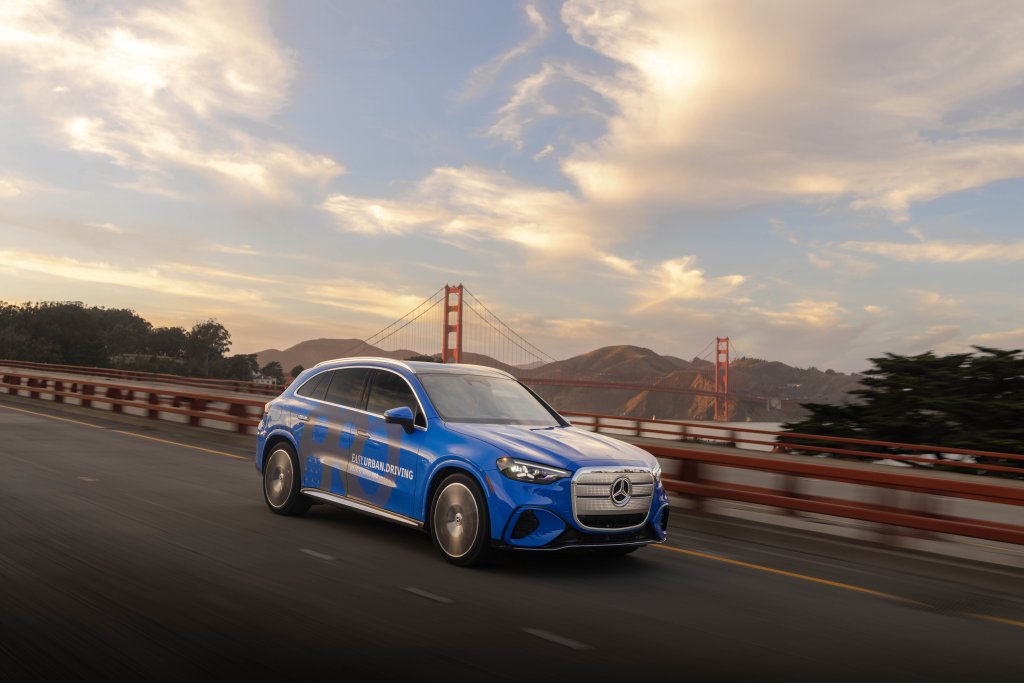
Mercedes-Benz is bringing its next generation of driver assistance technology to the U.S. in 2027, promising to make everything from highway cruising to navigating busy city streets a little less exhausting. The automaker is expanding its MB.DRIVE portfolio with two new systems: MB.DRIVE ASSIST PRO, which offers point-to-point driver assistance, and Hands-Free Highway Assist, which allows drivers to take their hands off the steering wheel on qualifying highways at speeds up to 85 mph.
Naturally, there’s a catch. Neither system makes a Mercedes-Benz autonomous, and drivers will still need to pay attention and remain ready to take control. But the technology represents another step toward making increasingly sophisticated driver assistance systems part of everyday driving rather than expensive technological novelties.
Before the nationwide rollout, Mercedes-Benz will begin a U.S. Early Access Program in California in December 2026, giving selected customers an opportunity to try both systems.
Hands-Free Highway Driving at Up to 85 MPH
The more immediately recognizable addition is Hands-Free Highway Assist. The system allows drivers to remove their hands from the steering wheel while traveling on eligible controlled-access highways, provided certain operating conditions are met.
The system requires Digital Extra: Distance Assist DISTRONIC to be active and supports hands-free operation at speeds up to 85 mph. It continuously monitors driving conditions and traffic while assisting with the routine business of highway travel.
For drivers who spend considerable time covering long distances, the potential benefit is obvious. Highway driving can be monotonous, particularly when traffic is moving steadily and the driver’s primary responsibility is maintaining speed and following distance. Taking some of that routine workload away could make longer journeys less tiring.
Mercedes-Benz is also including Proactive Lane Change Assist. This system can initiate and perform lane changes when conditions permit, including moving around slower traffic or positioning the vehicle for an upcoming highway exit along the navigation route.
There are, however, important limitations. Hands-Free Highway Assist is an SAE Level 2 driver assistance system, not autonomous driving. The driver remains responsible for the vehicle, must stay attentive and must be prepared to take control whenever necessary. Hands-free does not mean brain-free, despite what some drivers might wish.
The system will enter the California Early Access Program in December 2026 before expanding to select eligible Mercedes-Benz models across the U.S. in spring 2027.
MB.DRIVE ASSIST PRO Takes Things Beyond the Highway
The more ambitious technology is MB.DRIVE ASSIST PRO, which extends driver assistance beyond highway cruising and into the more complicated business of navigating everyday traffic.
With MBUX Navigation route guidance active, drivers can activate the system using a button on the steering wheel. From there, it can assist with a variety of driving situations along the planned route.
These include exiting highways, changing lanes, merging into appropriate traffic lanes, turning at intersections, and stopping and moving away from traffic lights.
In other words, Mercedes-Benz is attempting to make driver assistance useful for an entire journey rather than just the relatively straightforward portions spent cruising down an interstate.
That is a considerably more complicated proposition. Highway driving generally involves predictable traffic patterns, relatively consistent vehicle movement and fewer unexpected obstacles. Urban driving introduces intersections, pedestrians, cyclists, changing traffic signals and the occasional driver who apparently believes turn signals are an optional subscription service.
MB.DRIVE ASSIST PRO is designed to handle more of those situations while keeping the driver involved in the process.
The technology relies on an extensive collection of sensors and computing hardware. Mercedes-Benz says the system uses 27 sensing components, including 10 cameras, five radar sensors and 12 ultrasonic sensors.
Processing all that information requires a high-performance computer capable of delivering up to 254 TOPS (tera operations per second). That’s a substantial amount of computing power dedicated to understanding what’s happening around the vehicle and helping it respond appropriately.
As with Hands-Free Highway Assist, MB.DRIVE ASSIST PRO remains an SAE Level 2 system. The driver is still responsible for the driving task.
Which Mercedes-Benz Models Get the Technology?
Mercedes-Benz says the hardware required for MB.DRIVE ASSIST PRO is already installed in certain eligible 2027 vehicles. Those include the CLA Electric, GLE, GLS and S-Class.
Beginning with the 2028 model year, the company plans to expand hardware availability across more of its U.S. passenger vehicle lineup.
The California Early Access Program will begin in December 2026 and will be available to selected owners and lessees of specific vehicles. Eligible models include the 2026 and 2027 CLA Electric Sedan, 2027 GLC Electric SUV, S-Class Sedan, GLE SUV and Coupe, and GLS SUV.
The broader U.S. rollout of MB.DRIVE ASSIST PRO is planned to begin in 2027 on select eligible models.
Mercedes-Benz is also offering some flexibility in how customers purchase the technology. Depending on the vehicle and model year, buyers will be able to purchase the feature through the Mercedes-Benz Store, with delivery through an over-the-air software update on vehicles already equipped with the necessary hardware.
The automaker plans to offer multiple purchase periods, including three-year and one-year options.
This is another example of automakers increasingly treating vehicle technology as something that can evolve after a vehicle leaves the dealership. Rather than requiring a hardware upgrade or a trip to the service department, eligible Mercedes-Benz owners will be able to activate additional capabilities digitally.
A Global Push for Advanced Driver Assistance
Mercedes-Benz isn’t developing these systems exclusively for American drivers. The company is also rolling out MB.DRIVE ASSIST PRO in Germany and China.
China already received the system with the introduction of the new CLA at the end of 2025. With the planned U.S. and German launches, Mercedes-Benz says it will become the first automaker to offer this type of advanced point-to-point driver assistance system across all three markets.
The foundation for these technologies is Mercedes-Benz’s MB.OS operating system, which serves as the underlying architecture for the automaker’s latest generation of vehicle software and driver assistance features.
Mercedes-Benz says MB.OS combines its own expertise in vehicle integration, safety and driving dynamics with technologies from leading artificial intelligence partners. The company also intends to continue improving the systems through regular over-the-air updates.
For Mercedes-Benz, this is about more than simply adding another collection of electronic driving aids. The company sees advanced assistance technology as an increasingly important part of its luxury experience.
As Jörg Burzer, Mercedes-Benz’s chief technology officer, puts it, the goal is to make point-to-point journeys almost effortless through the combination of software, sensing and computing.
That’s an ambitious target, particularly when the system has to deal with real-world traffic rather than a carefully controlled demonstration route.
Still, the move toward more comprehensive Level 2 driver assistance is an important development. Highway assistance has become increasingly common among premium automakers, but extending those capabilities into urban driving is a much more demanding challenge.
Mercedes-Benz is betting that customers will appreciate technology that takes some of the tedious work out of driving without taking away the driver’s ultimate responsibility.
Whether it makes good on that promise will depend on how well the systems perform outside the carefully curated environments of an automaker’s press demonstration. The California Early Access Program should provide an early indication of whether MB.DRIVE can deliver the smoother, less demanding driving experience Mercedes-Benz is promising.
