

uesday the 20th was GM’s latest quarterly financials for 2026. GM CEO Mary Barra and board members walked through projected balance sheets with investors, breaking down expected drops in sales due to changes in product and the move from 2026 to all-new 2027 models in its highly profitable truck lineup. The downward projections immediately resulted in a 6 percent fall in GM shares.
Unlike with many meetings like this, GM didn’t pretend to downplay the problems it’s having. With the Silverado and Sierra trucks changing to a new generation (which normally means lower sales for a few months), it was expected that GM would see some profit drops, as projected. But, add in the cost of tariffs (about $3B), onshoring supply chain costs ($1.5B), and commodity inflation ($2B), and it’s clear that the company is definitely losing profits. Which means Wall Street short-termers don’t like GM right now.
The funny part, though, is that with all of this not-so-rosy projection from GM came a relatively quiet announcement of a $20B share buyback over the next few years. Giving the company incentive to keep those share prices falling.
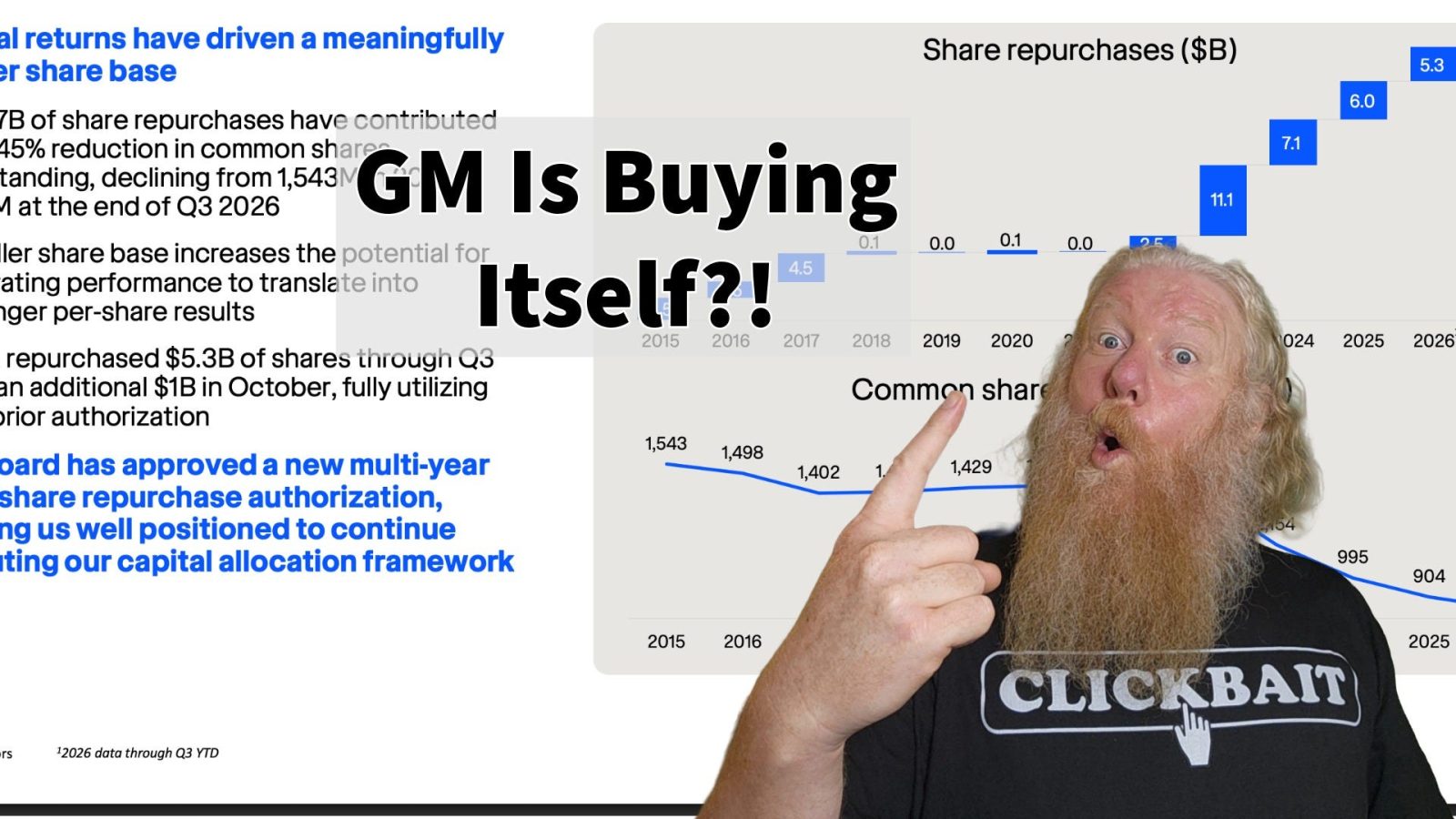
Since the initial announcement of share buybacks in 2015, GM has pulled in about 45 percent of its publicly-traded shares. Roughly $43B worth of stocks. This added $20B would potentially mean another 30-40 percent more.
That much re-buy would have two big consequences: remaining shares would have a much higher value and GM could own enough of itself to leverage itself out of being publicly traded.
That latter point is a big deal. Not because GM is likely to remove itself from the stock market, but because it gives GM the power to raise its own valuation under threat of doing so.
GM can keep turning a profit, that much is obvious. It’s been doing so pretty consistently for a long time. But its valuation on Wall Street hasn’t really changed much in that same period. Forward-looking potential earnings have remained in the low- to mid-single digits for two decades. Despite actuals at years’ end being generally much higher than that (usually 5-8, with a jump to 24.7 last year). This year’s p/e is at about 38.5 as an average, but forward p/e are still only 5.7.*
To be clear, no executives at GM are saying the company wants to go private. And the United Autoworkers Union is usually unhappy when companies buy shares instead of giving workers raises and bonuses. UAW’s president Fain has already called this buyback “legal mass looting.” But the potential is there for GM’s leadership to eventually take the company private and divest itself of Wall Street and its legal and financial influences.
And that gives GM a lot of financial power on Wall Street. Which is, clearly, the whole point here.
*Using Yahoo Finance and MacroTrends numbers for data presented in this paragraph.
This article originally published on the AaronOnAutos Substack.
