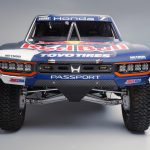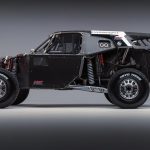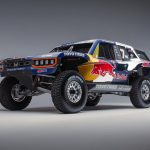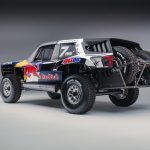

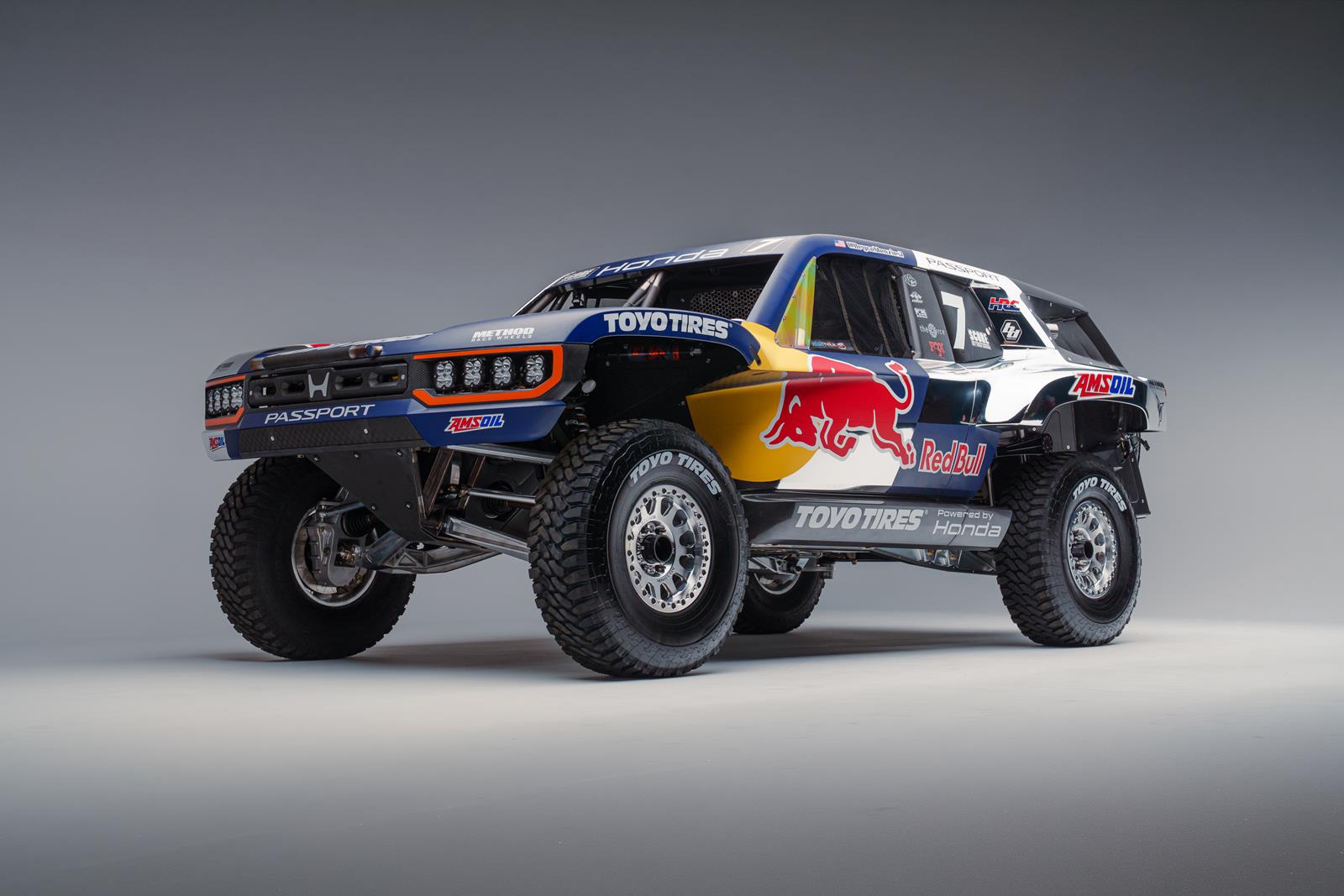
Honda is bringing hybrid technology to one of the most brutal motorsport environments on the planet. The Honda Racing Corporation USA (HRC US) has unveiled the Honda Passport Baja Spec, a 1,300-plus-horsepower Trophy Truck that aims to rewrite the rules of desert racing. And unlike the traditional fire-breathing V8-powered machines that dominate the SCORE World Desert Championship, this one has a hybrid powertrain.
That’s right. Honda is taking electrification to Baja, where the closest thing to a charging station is usually a support truck carrying extra fuel.
The Passport Baja Spec will be the first hybrid-powered entry in the SCORE World Desert Championship’s top Trophy Truck class. Developed by HRC US in Southern California in partnership with Mason Motorsports, the truck combines a twin-turbocharged V6, an 800-volt hybrid-electric architecture, advanced vehicle software and a purpose-built all-wheel-drive chassis.
Honda isn’t approaching this as a technology demonstration, either. The company has its sights set on an overall victory at the Baja 1000, with two-time Baja 1000 winner Bryce Menzies behind the wheel.
A 1,300-horsepower Hybrid for Baja
At the heart of the Honda Passport Baja Spec is a 2.4-liter twin-turbocharged V6 derived from the engine architecture used in the Acura ARX-06 GTP prototype race car. That engine has already proven itself in some of endurance racing’s toughest events, including the Rolex 24 at Daytona and the 12 Hours of Sebring.
Mounted behind the cab in a mid-engine configuration, the all-aluminum V6 works with a bespoke 800-volt hybrid-electric system to produce more than 1,300 horsepower.
That’s considerably more power than the naturally aspirated 9.0-liter V8 engines commonly found in today’s top Trophy Trucks. It also represents a significant departure from the traditional approach to desert racing, where displacement, mechanical simplicity and the ability to withstand tremendous punishment have historically been the name of the game.
The hybrid system isn’t simply there to improve fuel economy. This is a competition application designed to deliver enormous power while providing sophisticated control over how that power reaches the ground.
The engine and hybrid system were developed in-house by HRC US, drawing on Honda’s experience in Formula 1, IndyCar and IMSA competition.
Power is sent through a Mason Motorsports five-speed twin-angled drive transmission. The unusual drivetrain uses dual rear driveshafts to transfer torque to angled high-pinion spiral bevel gears at each rear wheel. This replaces the conventional ring-and-pinion arrangement and allows greater ground clearance while providing additional options for camber and toe adjustment.
Up front, a Mason Motorsports differential sends power to the wheels through portal gear sets mounted at each hub. The arrangement helps maximize ground clearance while accommodating the truck’s unusual all-wheel-drive architecture.
In other words, this isn’t a production Passport with a few extra turbos and some aggressive suspension bolted underneath. It’s a purpose-built racing machine wearing Honda Passport-inspired bodywork.
Formula 1 Technology Goes Off-Road
Perhaps the most interesting part of the Passport Baja Spec isn’t its horsepower. It’s the electronics and energy-management systems controlling it.
The hybrid system uses a lightweight battery pack designed, developed and manufactured by HRC US engineers. The pack incorporates previous-generation Formula 1-style pouch cells housed in a carbon-fiber enclosure.
Honda even constructed a dedicated clean room at its Santa Clarita headquarters for battery assembly, welding and validation. That’s a considerable investment for a vehicle that will spend much of its competitive life launching itself over rocks, sand and whatever other geological obstacles Baja can throw at it.
The battery technology is only one part of the electronics package.
HRC says the Passport Baja Spec will introduce several technologies to the Trophy Truck class, including dual-axle brake-by-wire, adaptive traction control and AI-assisted power deployment.
These systems are integrated through proprietary HRC software that connects the powertrain, chassis and energy-management systems into a single platform.
Kelvin Fu, president of Honda Racing Corporation USA, describes the truck as essentially a software-defined vehicle.
That description is particularly interesting in the context of desert racing. Trophy Trucks operate in constantly changing conditions, with drivers transitioning between loose sand, hard-packed dirt, rocks, whoops and deep ruts. Traction can change dramatically from one moment to the next.
An adaptive traction system capable of managing power delivery across four wheels could provide a meaningful advantage. Meanwhile, brake-by-wire technology could allow more sophisticated control over braking behavior and vehicle stability.
The ability to adjust software during a race also gives engineers another tuning tool. Rather than relying exclusively on mechanical changes, HRC can potentially modify power delivery and vehicle behavior to suit the driver, course and conditions.
Of course, software sophistication is only useful if it survives the environment. Baja is exceptionally good at finding weaknesses in complicated machinery, and Honda will have to prove that its electronics can withstand thousands of miles of vibration, heat, dust and punishment.
Aerodynamics Matter at 100 MPH
Honda and Mason Motorsports have also taken an unusually scientific approach to the truck’s aerodynamics.
The carbon-fiber body was developed using computational fluid dynamics (CFD) to optimize airflow and improve high-speed stability, efficiency and control.
Traditional Trophy Trucks are already aerodynamic exercises in managing enormous amounts of air, but Honda is taking things further with several unusual design features.
Deep channels behind the front wheels help direct airflow and reduce drag. High-mounted exhaust outlets behind the cockpit incorporate aerodynamic fins designed to manage exhaust flow while contributing to overall aerodynamic performance.
The cab also incorporates tunneling to reduce drag and direct airflow toward a cooling system mounted as far rearward and low as possible.
That placement serves two purposes. It helps manage temperatures while keeping weight low and toward the rear of the vehicle, improving overall weight distribution and lowering the center of gravity.
In a racing environment where a truck can spend considerable time airborne, maintaining predictable weight distribution and stability is important. Aerodynamics aren’t just about going faster in a straight line. They’re also about keeping the vehicle manageable when the terrain becomes unpredictable.
Built for the Baja 1000
Underneath the carbon-fiber body is Mason Motorsports’ Gen 2 All-Wheel-Drive chassis, developed in Lake Elsinore, California.
Mason has earned five consecutive SCORE Original Truck Chassis Manufacturer of the Year awards, making it a logical partner for Honda’s ambitious project.
The chassis was modified specifically for the hybrid powertrain, including a unique rear frame section designed to accommodate the V6 and electrical components while maintaining appropriate mass distribution.
One particularly interesting feature is the 145-gallon carbon-Kevlar safety fuel cell positioned centrally within the cab.
Mason’s philosophy revolves around maintaining consistent weight distribution as fuel is consumed. With that much fuel onboard, placement becomes especially important. The truck also positions several fixed-mass components, including fluid tanks and batteries, toward the rear to maintain balance.
Suspension duties fall to a long-travel setup with dual FOX Racing shocks at each corner. Toyo tires provide the contact patches needed to transfer all that power to the desert floor.
The combination should give Menzies the tools needed to tackle the brutal terrain that defines Baja competition.
Honda’s Long History in Baja
The Passport Baja Spec represents a new chapter in Honda’s desert-racing history, but the company has been involved with Baja long before the first official race.
In 1962, Honda dealers and desert-racing pioneers Dave Ekins and Bill Robertson Jr. rode two Honda CL72 motorcycles from Tijuana to La Paz in 39 hours and 56 minutes.
Their ride helped establish the foundation for organized desert racing on the peninsula. The official Baja 1000 followed in 1967.
Honda has since become the winningest motorcycle manufacturer in Baja history, with 22 overall victories and numerous class wins. Its four-wheel off-road program has added 17 class victories since 2015, including four Baja 1000 wins and five Baja 500 triumphs.
Now, the company wants to bring that experience into the premier Trophy Truck category with a hybrid.
The Passport Baja Spec will make its first public appearance at the 2026 SEMA Show in Las Vegas, November 3-6, at HRC’s booth (#24789). It will be displayed alongside 10 other HRC concepts and racing machines, including a new Passport TrailSport Baja Chase truck.
Its competitive debut is scheduled for the 2027 Baja 500, June 2-6, with Menzies Motorsports handling the racing partnership.
Honda is also targeting an overall Baja 1000 victory during the race’s 60th anniversary celebration in 2027.
That’s an ambitious goal. Trophy Truck competition is notoriously unforgiving, and introducing a high-voltage hybrid system adds another layer of complexity to an already demanding environment.
But there’s a compelling reason to watch this project. Honda isn’t simply trying to prove that electric assistance can work in desert racing. It’s applying decades of global motorsport development to an entirely new kind of off-road machine.
If the Passport Baja Spec succeeds, it could demonstrate that hybrid technology has a place even in the most horsepower-hungry, mechanically punishing forms of motorsport.
And if it doesn’t, well, at least Honda will have built a 1,300-horsepower hybrid Passport. That’s considerably more interesting than another crossover with a plug-in charging port.