

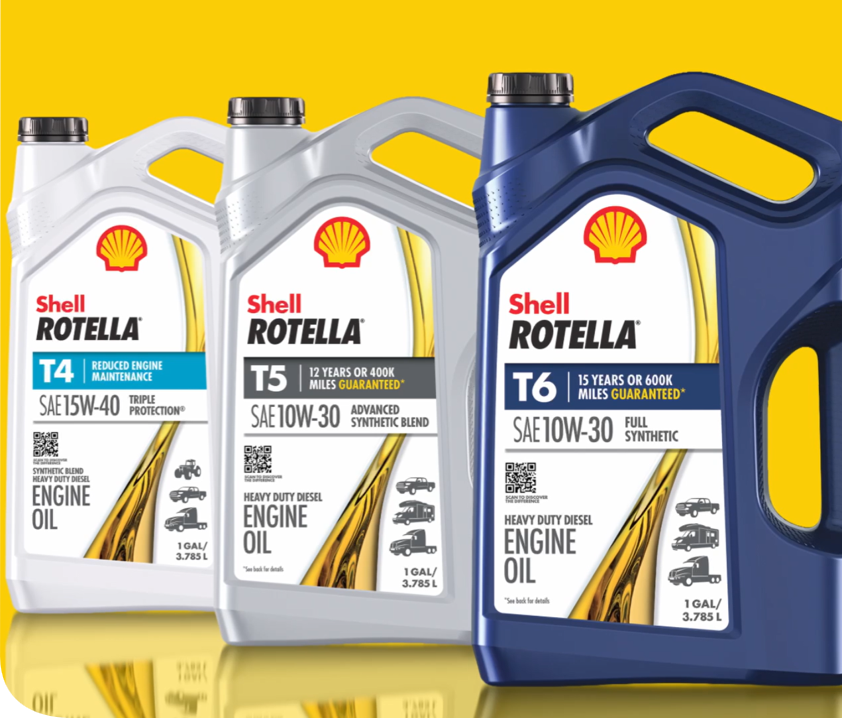
Shell Rotella is preparing to roll out a new generation of heavy-duty diesel engine oils in early 2027, promising improved engine protection, better fuel economy, and the potential for longer oil change intervals. The updated formulations are designed to meet new American Petroleum Institute (API) specifications that will support the next generation of diesel engines and emissions-control systems.
The changes represent the first major overhaul of heavy-duty diesel engine oil categories in approximately a decade. With the new API CL-4 and FB-4 specifications replacing the current CK-4 and FA-4 categories, lubricant manufacturers are working to keep pace with increasingly demanding engine designs and emissions requirements.
For trucking fleets, the potential benefits extend beyond engine longevity. Lower-viscosity formulations could reduce fuel consumption, improved oil stability could allow longer service intervals, and reduced ash-forming compounds could help extend the life of diesel particulate filters (DPFs).
New Oil Formulations Arrive in 2027
Shell Rotella’s upgraded lineup will include the T4 15W-40, T5 10W-30, and T6 10W-30 formulations. The new oils are being developed to meet the upcoming API specifications, which have a first licensing date of January 1, 2027.
According to Dr. Jason R. Brown, general manager of industry and transport lubricants at Shell, modern lubricant technology is making it increasingly possible to balance fuel efficiency with the engine protection commercial operators expect.
Historically, reducing oil viscosity to improve efficiency could introduce concerns about wear protection and durability under heavy loads. Advances in additive technology are helping lubricant manufacturers address those challenges without forcing fleets to choose between fuel savings and engine longevity.
That matters in an industry where even small improvements in fuel consumption can translate into meaningful savings. A fleet operating hundreds of trucks can benefit considerably from incremental efficiency gains, particularly when those gains are combined with reduced maintenance requirements.
Convincing operators to move away from familiar 15W-40 oils remains a challenge, however. Fleets tend to be understandably cautious about changing products that have demonstrated reliable performance over millions of miles. The new formulations will need to demonstrate their advantages under real operating conditions, not simply on laboratory test benches.
Protecting Modern Emissions Systems
The new specifications also address a less obvious source of maintenance expense: the ash that accumulates inside diesel particulate filters.
Small quantities of engine oil can enter the combustion chamber during normal operation. Although much of the oil is consumed, certain inorganic compounds remain as ash. Over time, those deposits accumulate in the DPF, increasing exhaust backpressure and potentially affecting engine efficiency.
Unlike soot, which can be burned off during regeneration, ash cannot be eliminated through the same process. Eventually, it must be removed through DPF cleaning or the filter must be replaced.
Reducing the compounds that contribute to ash accumulation can help extend aftertreatment service intervals and reduce maintenance costs. The updated oil formulations are designed to provide improved protection for modern emissions systems while supporting the demands of increasingly sophisticated diesel engines.
Better oxidation resistance is another important improvement. Engine oil degrades as it is exposed to heat and operating stresses, potentially forming deposits and losing some of its protective properties. Greater resistance to oxidation helps the lubricant maintain its performance for longer.
Engine manufacturers could use that improvement in two ways. They could operate engines at higher temperatures while using lower-viscosity oils to improve efficiency, or they could maintain existing operating conditions and potentially extend oil drain intervals.
The key distinction is that the new specifications enable these developments rather than automatically delivering every potential benefit. Actual results will depend on engine design, operating conditions, manufacturer recommendations, and the oil selected.
Shell Reports Improved Wear and Deposit Protection
Shell says its new formulations have delivered measurable improvements in testing.
The updated Rotella T4 15W-40 reportedly provides 58% stronger deposit control than its previous CK-4 formulation.
The T5 10W-30 exceeds oil breakdown requirements by more than 90%, while the T6 10W-30 provides an average of 66% more wear protection than required by the API CL-4 wear standards.
These figures represent Shell’s reported test results, rather than guarantees of equivalent improvements in every engine or operating environment. The company has supported its development work with laboratory testing and fleet trials spanning millions of miles. Testing covers a range of applications, including long-haul trucking, local delivery operations, off-highway equipment, and severe-duty applications.
One trial involved equipment operating at a combined weight of 160,000 pounds, providing an opportunity to evaluate lubricant performance under demanding loads.
Real-world testing is particularly important because standardized engine tests cannot reproduce every combination of temperatures, loads, idle time, driving patterns, and maintenance practices encountered by commercial operators.
Longer Oil Change Intervals Require Evidence
Extended oil drain intervals could offer another source of savings, reducing both lubricant consumption and the labor required for routine maintenance. However, improved oil technology does not automatically mean every truck can safely go longer between oil changes.
Shell evaluates used oil samples for viscosity, oxidation, acid and base numbers, and wear metals such as iron, nickel, aluminum, and copper. These measurements help engineers determine whether the oil is maintaining its protective properties and how much useful service life remains.
In some cases, the company removes engines from service and dismantles them to inspect internal components. Those inspections can then be compared with used oil analysis to determine whether laboratory measurements accurately reflect engine condition.
Shell is also exploring three-dimensional scanning to measure deposits on engine components more objectively. Conventional visual inspections can vary depending on the person evaluating the parts, while scanning technology could provide more consistent measurements.
Additional information from onboard engine sensors may eventually help engineers understand how lubricants perform under specific operating conditions.
For fleets, the practical takeaway is straightforward: longer oil change intervals should be based on engine manufacturer recommendations, appropriate oil specifications, operating conditions, and oil analysis where applicable. Simply pouring in a more advanced lubricant and extending the service schedule is not a sound maintenance strategy.
Longer Warranties for Rotella T5 and T6
Alongside the new formulations, Shell is expanding warranty coverage for two products in its Rotella lineup. The Rotella T5 Advanced Synthetic Blend warranty will increase from 10 years or 300,000 miles to 12 years or 400,000 miles. The Rotella T6 Full Synthetic warranty will increase from 15 years or 500,000 miles to 15 years or 600,000 miles. Coverage for the Rotella T4 Triple Protection remains unchanged at up to 10 years or 300,000 miles.
The revised coverage offers additional reassurance for customers investing in higher-performance lubricants, although operators should review the applicable warranty terms and conditions. Shell plans to introduce the upgraded formulations in phases beginning in early 2027, with availability varying by product.
What It Means for Diesel Owners and Fleets
The next generation of Shell Rotella oils reflects a broader shift in diesel engine development. As manufacturers pursue greater efficiency and tighter emissions control, lubricants must do more than simply keep moving parts separated by a protective film.
They must also support aftertreatment durability, resist breakdown under increasingly demanding operating conditions, and potentially help reduce the maintenance burden associated with commercial diesel engines.
For large fleets, the combination of modest fuel economy improvements, fewer DPF service events, and potentially longer oil change intervals could produce meaningful operating savings.
Owner-operators and smaller fleets may also benefit, although the value will depend on the specific engine, annual mileage, operating conditions, and cost of the selected lubricant.
The new formulations are not a reason to abandon established maintenance practices or assume every diesel engine will benefit equally from lower-viscosity oil. Compatibility and manufacturer recommendations remain essential.
Still, the upcoming API specifications mark an important step in the evolution of heavy-duty diesel lubricants. If Shell’s reported testing results translate into dependable real-world performance, the new Rotella lineup could help fleets reduce operating expenses while maintaining the durability their businesses depend on.
For truck owners, the most important development may not be a dramatic increase in horsepower or a new emissions-system gadget. It may be something considerably less exciting but potentially more valuable: an engine that uses less fuel, protects its emissions equipment more effectively, and spends less time in the shop.
