
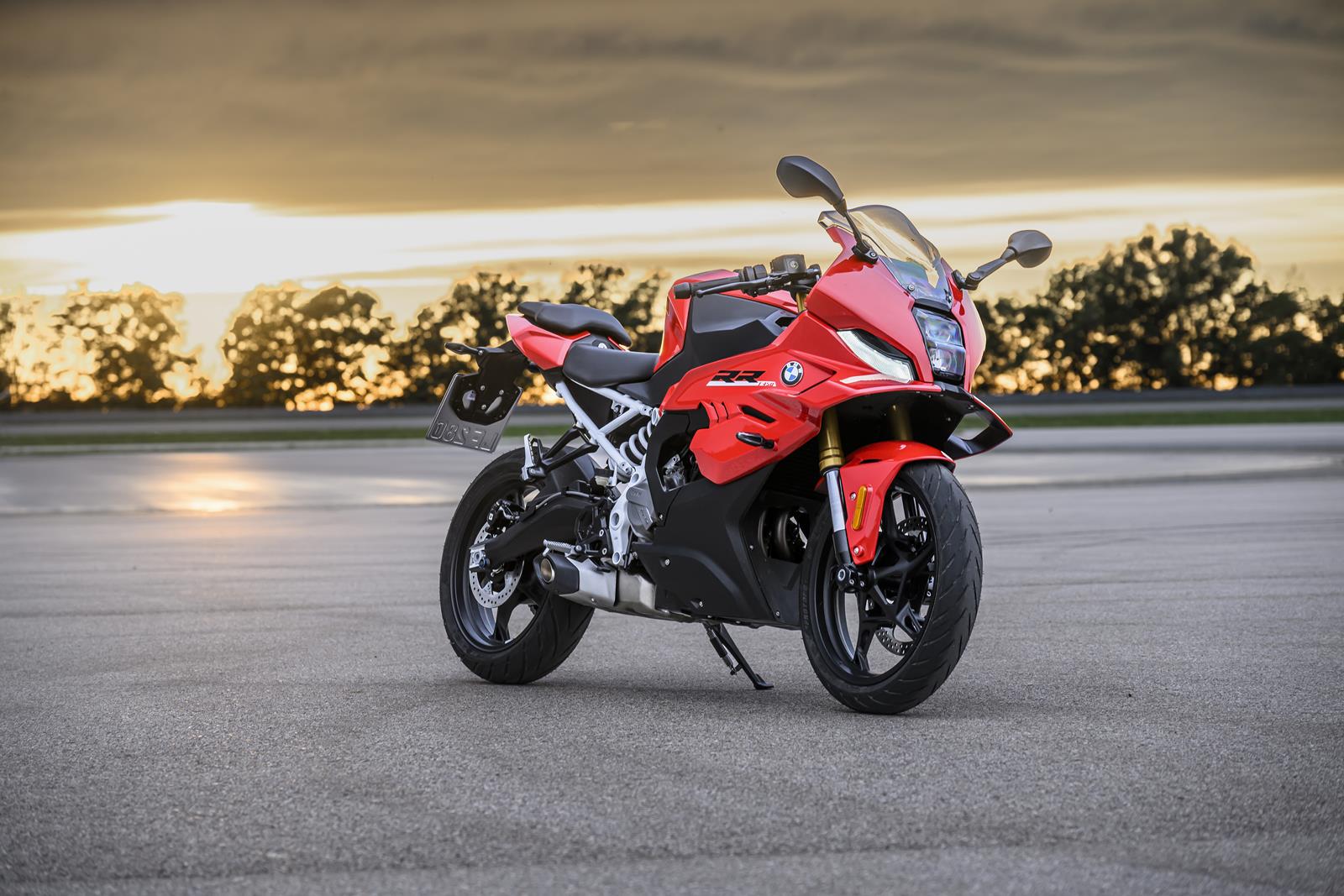
BMW Motorrad is expanding its sportbike lineup with the 2027 BMW F 450 RR, a lightweight supersport motorcycle designed to bring the company’s performance heritage to a broader audience. With a 420cc parallel-twin engine, sophisticated electronics, adjustable suspension, and styling inspired by the flagship S 1000 RR, the new motorcycle aims to deliver a proper sportbike experience without requiring riders to wrestle with a liter-class machine.
The F 450 RR will initially arrive in the United States exclusively in M Sport trim, with a starting MSRP of $7,815. That puts it in an appealing position for riders looking to move into the supersport category without committing to the power, weight, and expense of a larger performance motorcycle.
BMW Motorrad CEO Markus Flasch describes the new model as a lightweight, precise motorcycle equally suited to winding roads and racetrack use. The company also sees it as an entry point into its RR family, bringing the styling and engineering philosophy of its larger sportbikes to a more accessible package.
A Smaller Sportbike With Big BMW Ambitions
The F 450 RR joins BMW’s growing F 450 family as a dedicated supersport model. Although it shares its basic engine architecture with the F 450 GS, the RR receives specific tuning and chassis engineering intended to support more aggressive riding.
Its design borrows heavily from the larger S 1000 RR, with a nose-down, tail-up stance, distinctive winglets, asymmetrical fairing panels, and signature BMW sportbike styling. The bodywork incorporates characteristic side gills and a split-face design, giving the motorcycle a recognizable appearance without simply shrinking the company’s flagship sportbike.
BMW also draws inspiration from its history. The low front end references the 911 GT1 race car, while the roofline of the motorcycle’s bodywork takes inspiration from the Porsche 959. The company even looked to the Porsche 917’s radiator fan arrangement when developing the motorcycle’s cooling-system design.
The wheels take inspiration from the distinctive dial-style designs of the Porsche 928.
Those automotive connections make for an unusual collection of design references, but the underlying objective is straightforward: give the F 450 RR a visual identity that connects it to performance machines with serious motorsport credentials.
The fuel tank, two-piece seat, and slim tail section form a continuous, forward-oriented profile. Passenger grab handles are integrated discreetly into the tail, while passenger footpeg brackets attach to the rear frame.
The riding position is sporty without being designed exclusively for track use. Clip-on handlebars connect directly to a forged-aluminum triple clamp, and the carefully arranged ergonomic triangle is intended to provide control during aggressive riding without making everyday trips unnecessarily uncomfortable.
Seat height is 31.1 inches, with optional high and low seats available through BMW Motorrad Accessories. The standard seat is designed to balance an active riding position with reasonable comfort.
A 420cc Twin With a Distinctive Personality
Power comes from a liquid-cooled, 420cc parallel-twin engine with a 72mm bore and 51.6mm stroke. It produces 48 horsepower at 8,750 rpm and 32 lb-ft of torque at 6,750 rpm.
Those numbers won’t frighten anyone accustomed to high-powered superbikes, but the F 450 RR isn’t intended to compete directly with machines producing twice the output. Instead, BMW is targeting a combination of accessible performance, manageable power delivery, and engaging handling.
The engine produces 80% of its maximum torque at just 3,000 rpm, according to BMW. That should help make the motorcycle responsive during everyday riding, where useful low- and midrange power can be more valuable than a peak output figure that requires running the engine near its limits.
The engine’s most unusual feature is its 135-degree crankpin offset. Combined with a counter-rotating balance shaft, the arrangement is designed to produce a distinctive exhaust note while keeping vibration under control.
BMW also uses magnesium covers for the clutch and transmission as part of its weight-reduction strategy. The engine incorporates two overhead camshafts and four valves per cylinder, with lightweight rocker arms designed to accommodate high engine speeds. A 13:1 compression ratio and port fuel injection round out the engine’s principal specifications.
A stainless-steel under-belly exhaust system houses two catalytic converters. Its central position helps preserve cornering clearance while reducing the likelihood of contact with passengers or luggage.
BMW hasn’t provided a final wet-weight figure in the supplied specifications, so the motorcycle’s precise power-to-weight ratio remains unconfirmed. Nevertheless, its compact engine and extensive use of weight-conscious components reflect the company’s focus on agility.
A Clutch That Can Almost Disappear
One of the F 450 RR’s more interesting features is its optional Easy Ride Clutch, or ERC.
Available on the M Sport variant, the system uses a centrifugal mechanism to engage the clutch according to engine speed. When combined with the standard Shift Assistant Pro, it allows riders to change gears without manually operating the clutch lever.
Unlike some conventional centrifugal clutch arrangements, BMW’s system remains engaged during overrun. This preserves engine braking until the motorcycle approaches a stop. Once engine speed reaches idle, the clutch opens automatically to help prevent stalling.
The practical benefit is reduced effort in stop-and-go traffic, particularly for riders who spend time commuting or navigating urban streets. It could also make low-speed maneuvers less demanding for newer riders.
Importantly, BMW says the system retains predictable engine braking and familiar riding behavior rather than making the motorcycle feel disconnected from the rider.
The six-speed transmission includes a standard quickshifter on the M Sport model, allowing rapid clutchless upshifts and downshifts. BMW says this also reduces unwanted weight transfer during gear changes, helping maintain rear-wheel traction.
For track use, riders can reverse the standard shift pattern to a racing-style configuration, with first gear up and the remaining gears down. That arrangement can make shifting more natural when accelerating out of corners while the motorcycle is leaned over.
Modern Electronics and Adjustable Suspension
The F 450 RR comes equipped with a substantial collection of electronic rider aids for its class.
Standard systems include ABS Pro, Dynamic Brake Control, Dynamic Traction Control, and engine drag torque control. Three riding modes—Rain, Road, and Race—adjust throttle response and electronic intervention to suit different conditions.
Rain mode softens throttle response and prioritizes stability. Road mode provides more direct response while retaining a balanced approach to traction and braking assistance. Race mode reduces intervention from traction control, front-wheel lift detection, and engine drag torque control to provide a more direct riding experience.
The M Sport model adds Riding Modes Pro, including a configurable Race Pro mode that lets riders tailor throttle response, traction control, and ABS behavior.
Suspension hardware also reflects the motorcycle’s performance ambitions.
A 43mm KYB inverted front fork provides 5.5 inches of travel. On the M Sport model, the fork offers adjustable compression and rebound damping. At the rear, a hollow-cast aluminum swingarm works with a centrally mounted KYB shock absorber, which provides adjustable spring preload and rebound damping.
The chassis uses a welded tubular steel space frame, with the engine serving as a load-bearing element. BMW says the layout was developed specifically to provide precise turn-in, agile handling, and stability on both public roads and racetracks.
The wheelbase measures 55.3 inches, with a 23.4-degree steering-head angle and 4.3 inches of trail.
Braking hardware consists of a 310mm front disc with a Brembo four-piston monobloc caliper and a 240mm rear disc with a single-piston ByBre caliper. ABS Pro is designed to assist braking while leaned over, helping reduce wheel lockup and unwanted changes in steering behavior.
Everyday Equipment Comes Standard
BMW hasn’t treated the F 450 RR as a stripped-down sportbike that requires a long options list to become useful.
Standard equipment includes heated grips, full LED lighting, adjustable brake and shift levers, and a 6.5-inch color TFT display with connectivity. A USB-C charging port is positioned in the cockpit.
The display provides access to phone calls, music, and navigation functions through a compatible smartphone and helmet communication system. BMW Motorrad’s Connected app supports turn-by-turn navigation directly on the screen.
Riders who want full map navigation can opt for navigation preparation, which supports BMW’s ConnectedRide Navigator or a compatible smartphone cradle.
The M Sport model also offers additional display layouts with information such as braking force, lean angle, traction-control activity, and lap times. Those features should appeal to riders who want to monitor their performance during track sessions.
The motorcycle will initially be offered in the United States in Snaefell White with M Motorsport graphics, a white frame, and matching wheel decals.
The $7,815 MSRP includes the M Sport equipment package, with its Race Pro riding mode, Shift Assistant Pro, and sport suspension.
BMW also includes its Ultimate Care Break-In Service on 2027 and 2028 model-year motorcycles. The service must be completed within six months of the in-service date or before the motorcycle reaches 750 miles, whichever comes first.
A New Entry Point Into BMW’s RR Family
The 2027 BMW F 450 RR takes a familiar approach to the lightweight sportbike formula: combine manageable power with a chassis designed for precise handling, then add electronics and equipment that make the motorcycle useful beyond occasional track days.
Its 48-horsepower engine places it in an accessible performance category, while adjustable suspension, cornering-capable ABS, traction control, and a quickshifter provide features that riders might otherwise expect to find on larger motorcycles.
The optional Easy Ride Clutch is another interesting addition, particularly for riders who want the convenience of reduced clutch operation without sacrificing traditional engine-braking behavior.
At $7,815, the F 450 RR also gives BMW an opportunity to attract riders who might eventually move into its larger RR models. Whether the motorcycle can deliver the handling precision and overall refinement suggested by its specifications will ultimately depend on real-world riding impressions.
Still, BMW appears to have a clear idea of what the F 450 RR should be: a compact, approachable supersport motorcycle that emphasizes agility, usable performance, and the connection between rider and machine.
For riders who want a sportbike that can entertain on a winding road, serve as a daily commuter, and handle occasional track sessions without demanding superbike-level commitment, the F 450 RR looks like an intriguing new option.